
x
If you’re under pressure to cut logistics costs while keeping delivery promises, warehouse and logistics management becomes the control centre. This guide shows how to organise the warehouse, standardise operations and apply ISO 9001 so your storage network runs safely, accurately and close to your customers.
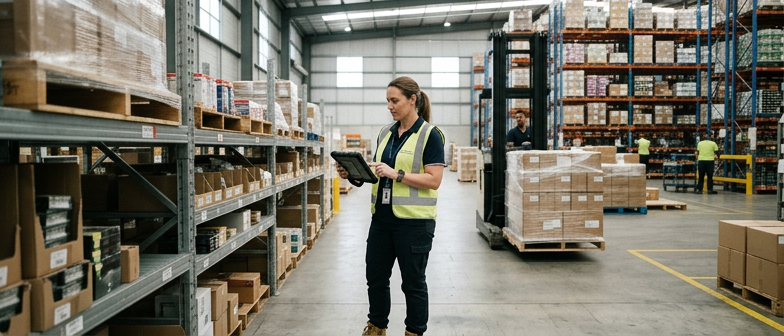
Warehouse and logistics management covers everything from how goods are received, stored and picked to how they are packed, shipped and tracked. Effective warehouse logistics turn static storage into a coordinated flow of materials, information and transport, linking manufacturers, importers, wholesalers and retailers into one continuous supply chain. For Australian businesses dealing with long transport distances, volatile demand and strict delivery windows, this coordination is essential to keep inventory available in the right locations without tying up too much capital in stock.
Strong warehouse service underpins customer experience, cost control and compliance. Accurate receiving and put-away reduce stock losses and errors, while well-designed processes limit handling, minimise damage and improve labour productivity. This directly supports on-time delivery performance and reliable order fulfilment, which customers increasingly expect even in regional and remote areas. At the same time, good management of warehousing and logistics must align with workplace health and safety obligations and quality standards, ensuring that every movement of goods is not only efficient but also safe, traceable and auditable.
Designing an efficient warehouse starts with understanding what you store, how fast it moves and which customers or production lines it serves. Effective warehouse operation management treats the building as a flow system, not just a storage box. Fast‑moving or high‑value items sit close to receiving, packing and dispatch, with clear travel paths that minimise cross‑traffic between people, forklifts and vehicles. Aisle widths must suit the equipment used, racking must match pallet and carton sizes, and signage should be clear for both permanent and casual staff to support accurate and safe movement of stock.
Organising warehouse space means standardising locations and processes so anyone can find, pick and put away goods without guesswork. Fixed or well‑controlled flexible locations, simple coding of aisles, bays and shelf levels, and visible reference maps reduce errors and speed up training. Barcode or RFID scanning keeps inventory records aligned with physical stock, improving the reliability of your warehouse service to internal teams and customers. Separating receiving, quarantine, storage, value‑adding and dispatch areas reduces mix‑ups and supports quality checks before goods move on.
From a management perspective, an efficient layout and workflow depend on repeatable procedures, safety planning and continuous improvement. Warehouse operation management should define standard work for receiving, put‑away, replenishment, picking, packing and stocktaking, and track performance with measures such as order accuracy, pick rate and dock turnaround time. Walk‑throughs, toolbox talks and incident reviews help expose congestion, unsafe stacking or confusing labelling. By adjusting layout and work instructions and involving operators in solving issues, the warehouse stays accurate, fast and safe in daily operations.
| Layout or organisation choice | Impact on speed | Impact on accuracy | Impact on safety | When this choice fits best |
|---|---|---|---|---|
| Fast movers near dispatch | High | Medium | Medium | High order volumes |
| Standardised location coding | Medium | High | Medium | Mixed experience workforce |
| Separate receiving and dispatch zones | Medium | Medium | High | Heavy vehicle traffic |
| Barcode or RFID scanning | Medium | High | Medium | Service level focus |
| Wide aisles matched to equipment | Medium | Medium | High | Frequent forklift use |
| Visual maps and signage | Medium | Medium | Medium | Casual or seasonal staff |
Effective warehouse operation management depends on standardised routines so warehouse logistics run consistently on every shift. Inbound tasks such as receiving, checking and put-away need clear work instructions, barcode or RFID checks and basic safety rules at docks and forklifts. Storage rules covering location labelling, separation of dangerous goods and FIFO or batch control must be documented and trained so any team member can locate stock quickly and keep inventory records accurate. The rest of the process chain focuses on picking, packing and dispatch, where most service failures and extra costs appear if workflows are loose. Standard pick paths, scan validation and simple visual cues cut travel time and mis-picks, while clear packing rules define carton choice, protection and labels. Dispatch procedures that match carrier cut-off times, loading checks and proof of despatch help maintain on-time service and a reliable logistics backbone.
Using ISO 9001 in warehouse and logistics management means treating every stock movement as part of a structured quality system. Instead of relying on tribal knowledge, a quality-driven warehouse defines clear processes for receiving, put-away, picking, packing and dispatch, with responsibilities documented and communicated. Quality objectives such as order accuracy, on-time dispatch and damage rates are set, measured and reviewed, so the warehouse logistics function supports broader business goals rather than operating as a backroom cost centre.
ISO 9001 warehouse management principles shape daily warehouse operation management. Standard operating procedures, work instructions and visual aids help teams complete tasks consistently, even during peak periods or staff turnover. Documented controls for labelling, traceability and inventory accuracy reduce complaints and rework. When incidents occur, structured root-cause analysis and corrective actions are used, so problems in storage, handling or transport lead to lasting improvements instead of quick fixes.
A quality-focused warehouse service also depends on leadership and continual improvement. Managers provide resources, training and safe systems of work that meet ISO 9001 requirements and local safety obligations. Data from audits, cycle counts, customer feedback and carrier performance is analysed to refine layout, material handling methods and information flow across the logistics chain. Over time, this disciplined approach builds a culture where people actively look for better ways to work, increasing reliability and customer confidence in every shipment.
In warehouse and logistics management, documented procedures turn day‑to‑day tasks into a controlled Warehouse Service rather than a collection of individual habits. An ISO 9001 warehouse management approach starts by mapping each critical activity, such as receiving, put‑away, picking, packing, and dispatch, and then writing clear, version‑controlled work instructions for each step. These documents define responsibilities, required checks, and records to be kept, so that staff training, safety obligations, and customer expectations are aligned. When procedures are easy to access on the floor, reviewed after incidents or near misses, and updated through a simple change process, they become a live system that supports consistency instead of paperwork that sits on a shelf.
Effective warehouse operation management starts with treating safety and compliance as non‑negotiable business requirements rather than box‑ticking. Managers are expected to identify key hazards such as traffic movements, manual handling, racking collapse, forklift interaction with pedestrians and working at height, then apply controls that match local work health and safety laws and guidance. A robust warehouse service will use documented risk assessments, clear safe work procedures, traffic management plans and emergency response arrangements, supported by training, supervision and incident reporting that all feed back into continuous improvement.
Risk management also relies on disciplined housekeeping, accurate inventory placement and well‑designed workflows so that aisles stay clear, loads are stable and staff can access stock without shortcuts. Regular inspections of plant, racking and fire protection, plus preventative maintenance, reduce the chance of breakdowns that disrupt operations or create new hazards. When safety expectations are built into everyday warehouse operation management decisions, from rostering and contractor control through to how technology is deployed, the result is fewer injuries, less downtime and more reliable service levels for customers who depend on timely and accurate warehouse service.
How does warehouse and logistics management support long‑distance supply chains?
It coordinates receiving, storage, picking and transport so stock sits in the right locations, transit times are planned, and carriers meet strict delivery windows without inflating inventory levels.
What are the basics of organising a warehouse for fast, accurate picking?
Group fast movers near receiving and dispatch, separate pedestrian and forklift routes, size aisles to the equipment, label locations clearly and keep travel paths short and uncluttered.
What core warehouse operations should be standardised?
Receiving, checking, put‑away, location control, picking, packing and dispatch all need clear work steps, barcode checks, safety rules and defined hand‑offs between teams and systems.
How does ISO 9001 improve warehouse management quality?
It requires documented processes, defined responsibilities and measurable objectives such as order accuracy, damage and on‑time dispatch, driving continual improvement instead of ad‑hoc fixes.
What should I look for when choosing a logistics warehouse near my customers?
Check proximity to key delivery areas, safety and compliance record, process documentation, IT integration, cut‑off times, accuracy performance and how transparently they report service levels.