
x
Behind every 5G antenna, EV powertrain, and ultra‑dense semiconductor lies a quiet layer of probes, analyzers, adapters, and smart benches validating each signal, weld, and waveform. Increasingly automated, data‑rich, and AI‑driven, these precision systems now shape how quickly—and safely—new electronic ideas reach the real world.
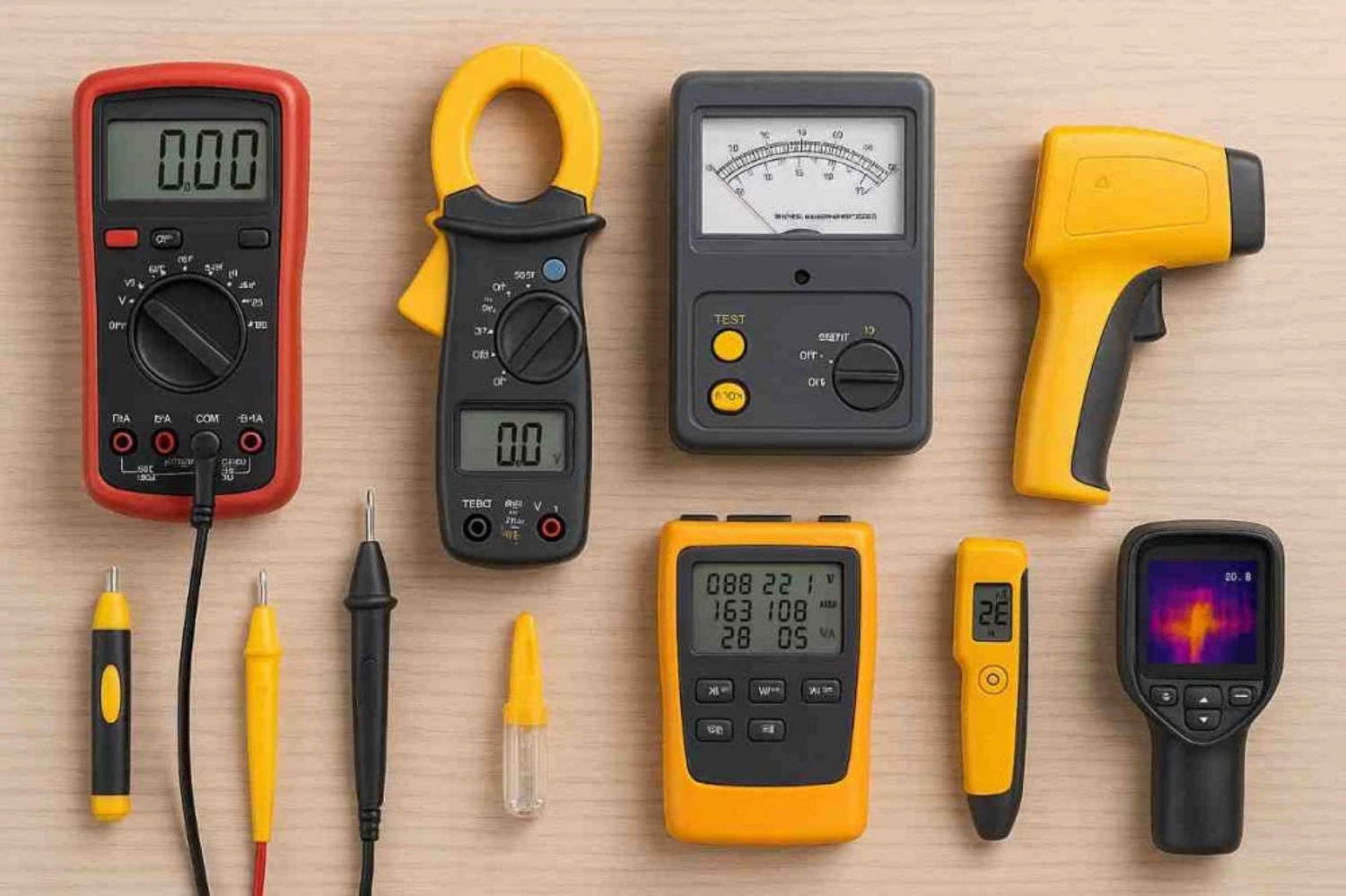
Every electronic product, from tiny wearables to industrial drives, depends on one simple fact: internal signals must behave as intended. Engineers spend much of their time checking whether voltages, currents and waveforms at critical nodes actually match design assumptions. The tools that touch those nodes – clips, probes, sockets and fixtures – decide how much “truth” they see. Early, slow, low‑density hardware tolerated bulky clips and long ground leads. Modern high‑speed boards with sub‑millimetre pads and ultra‑fast edges do not. A casual wire can turn a measurement into a disturbance, changing impedance, adding inductance, or injecting noise. Probing has therefore evolved into a discipline of its own: making repeatable, low‑intrusion contact that reveals real behaviour without rewriting it in the process.
Shrinking boards, stacked packages and dense connectors leave almost no room for test access. Micro‑clips and SMD grabbers must land reliably on pads smaller than a grain of sand, grip without damaging leads, and endure thousands of cycles. At radio and high‑speed digital frequencies, each probe becomes part of the signal path rather than a simple conductor. Specialised accessories control geometry and impedance to minimise reflections and resonances; some use coaxial structures so the transition from board to instrument stays as continuous as possible. In production or long‑term stress rigs, pogo pins and Kelvin clips are engineered for stable resistance and long mechanical life, otherwise slowly rising contact resistance quietly skews measurements over months of repetitive tests.
At the other extreme, traction inverters, battery packs and power modules demand clips that tolerate large voltages and currents while protecting users. Jaws grow wider, insulation thicker, and creepage distances longer. Metal sections must carry current without excessive temperature rise; even modest extra resistance at the jaws can create hot spots and distort readings. These setups frequently pair with source‑measure units, which inject precisely controlled current or voltage while measuring response. Four‑terminal Kelvin clips route separate sense leads directly to the device, excluding the drop across leads and contacts. Without that arrangement, carefully specified accuracy at the instrument is wasted in the wiring. In many labs, the humble clip quietly decides whether power‑device curves reflect silicon reality or just connector artefacts.
| Usage focus | Contact challenge | Typical accessory choice |
|---|---|---|
| High‑speed digital I/O | Minimise loading and reflections | Coaxial or active probes with micro‑clips |
| Precision low‑ohmic | Eliminate lead and jaw resistance | Four‑wire Kelvin clips or spring probes |
| High‑energy power | Limit temperature rise and arcing | Insulated, wide‑jaw, high‑current clamps |
| Dense SMD debugging | Reach tiny pads between components | Fine‑pitch grabbers and custom fixtures |
Careful selection across these categories often matters more than headline instrument specs, especially when debugging edge‑case failures.
Whenever time‑varying behaviour matters, oscilloscopes become the primary window into a design. They draw voltage versus time, exposing rise times, overshoot, ringing, jitter and noise that simple meters ignore. Yet the instrument alone is only half the story; front‑end probes and measurement strategy shape what the display shows. High‑bandwidth active probes place buffering close to the circuit, lowering capacitive loading and preserving edge fidelity. Ground connections shrink to tiny springs or coax collars, because long flying leads act like antennas and inductors, stretching edges and inventing extra ringing. With data rates climbing, teams look not only at “can I see a square wave” but at eye diagrams, bit‑error margins, crosstalk paths and power‑integrity dips hiding inside complex topologies.
During early development, oscilloscopes roam freely: engineers move tips from point to point, exploring buses, regulators and reference rails. As products mature, the same measurement concepts migrate into fixtures and automated stations. Instead of chasing every detail, factories focus on whether critical parameters sit inside allowed windows. Custom clamps, flip‑top sockets and bed‑of‑nails fixtures guide signals into moderate‑bandwidth probes with maximum repeatability and minimum handling. Mixed‑signal scopes then monitor both analogue behaviour and digital states together, so power rail droops and protocol errors appear on the same timescale. Lessons learned in this environment flow back upstream: once a dangerous margin or noisy edge is visualised on a prototype, it often becomes a defined limit in the end‑of‑line checklist.
Printed ratings on housings say little about how hardware handles real‑world stress. Power analyzers and related instruments study energy flow as conditions change: load steps, frequency shifts, harmonics, regenerative braking or grid disturbances. They track instantaneous voltage and current at several points, calculate power factor, separate switching from conduction losses, and highlight where each watt of heat originates. Wide‑bandgap converters, fast chargers and drives run with extremely steep edges, so timing resolution and bandwidth must be high enough to resolve individual transitions. That detail lets teams tune gate drive, snubbers and layouts, trading slightly gentler edges for significantly lower stress and better efficiency where needed.
Electric drivetrains, depot chargers and distribution panels share tightly coupled behaviour. A traction inverter’s switching pattern shapes current drawn from a fast charger; combined charger loads shape local voltage distortion; that distortion feeds back into both vehicles and nearby equipment. Coordinated test campaigns therefore combine power analyzers, fault generators and recorders. They emulate various driving cycles, parking patterns and generation profiles while logging harmonics, imbalance and transient responses. Data from these sessions informs design decisions for busbars, protection schemes and thermal management long before hardware reaches a public road, car park or substation.
| Scenario goal | Measurement emphasis | Helpful instruments combination |
|---|---|---|
| Optimise inverter efficiency | Switching energy and harmonics | Power analyzer + high‑bandwidth scope + probes |
| Validate fleet charging strategies | Aggregate demand and grid impact | Multi‑channel logger + programmable loads |
| Characterise distribution busbars | Temperature rise and imbalance | Power analyzer + multi‑point temperature sensing |
| Tune microgrid or storage behaviour | Bidirectional flow and stability | Power analyzer + disturbance generator + recorder |
Using such combinations turns vague “kW” claims into concrete understanding of where stress, waste and margin really sit in an interconnected system.
Traditional benches waited for humans to choose ranges, trigger captures and interpret traces. Modern integrated rigs couple sensors, instruments, switching matrices and control software into one cyber‑physical loop. They feel voltages, currents, temperatures and communication traffic in real time, make local decisions, and adjust conditions on the fly. During surge trials, they monitor not only device survival but also whether injected waveforms actually meet targets; failed injections are flagged instantly rather than silently skewing results. On vehicle or inverter stands, they cross‑link electrical data with thermal and mechanical channels, revealing conditions where protections trip late or margins erode. Instead of engineers manually shuffling clips and cables through hundreds of points, switching networks step systematically through maps defined in software.
Automation turns sporadic snapshots into continuous histories. Each test run produces rich records: waveform fragments, temperature ramps, protocol logs, error counters and protective actions. Over time, benches learn normal patterns for a product family and highlight slow drifts indicating tooling wear, contact degradation or subtle design regressions. Production lines use this awareness to tighten or relax sampling rates for particular tests as early trends appear. Service and design teams mine the same database when field failures surface, checking whether similar waveforms or fault signatures appeared during qualification. In safety‑sensitive applications, rigs keep their own audit trails, documenting conditions, thresholds and decisions around every emergency shutdown, so rule sets can be reviewed and improved instead of remaining opaque.
As features shrink, each transistor becomes more sensitive to variation, and each block must share space with many neighbours. A single die might combine high‑speed logic, RF front‑ends, precision references, converters and brutal power stages. Verification therefore spans timing, jitter, spectral purity, distortion, leakage, noise immunity and ageing, often within one piece of silicon. Vector network analyzers explore tiny passive structures; spectrum and signal analyzers check emissions and modulation; protocol testers feed realistic traffic while scopes watch power rails sag during peaks. Correlating these layers shows, for example, how a digital burst shifts a radio’s noise floor, or how a temperature gradient moves a reference out of its comfort zone.
Transistors built from gallium nitride and related materials push voltages, frequencies and power densities higher than traditional technologies. That progress brings tight thermal gradients, high electric fields and new failure modes. Characterisation campaigns therefore run from gentle leakage sweeps up to aggressive repetitive switching under elevated temperature. Source‑measure units, high‑power supplies, fast scopes and thermal imaging work together to map behaviour from microamps to hundreds of amps. Packaging parasitics and layout details receive as much attention as bare die, because a few nanohenries of stray inductance can completely change dynamic performance. Accelerated life tests bridge bench seconds with field years, generating statistics that later drive derating guidelines, safe‑operating‑area diagrams and warranty decisions. In many ways, the measurement chain – from probe tip to database – becomes as critical a piece of infrastructure as the fabrication line that produced the silicon.
What factors should I consider when selecting electronic test equipment for a new lab?
Focus on measurement range and accuracy, bandwidth, input protection, connectivity (USB/LAN), software ecosystem, safety ratings, calibration support, and expandability so the instruments can grow with future test needs.
How do test equipment manufacturers in the USA typically differentiate their products?
They compete on measurement performance, compliance with international standards, software integration, automation interfaces, long-term calibration and repair services, plus industry focus such as aerospace, automotive, or telecom.
What are the main types of electronic test equipment used in electronics R&D?
Common types include oscilloscopes, signal and waveform generators, spectrum and network analyzers, digital multimeters, power supplies, electronic loads, protocol analyzers, and dedicated compliance testing instruments.
How can a company optimize costs when building an equipment testing setup?
Use modular instruments where possible, prioritize multi-function equipment, consider certified refurbished units, standardize on fewer platforms to reduce training, and outsource rare or highly specialized tests to external labs.
Why is regular calibration critical for electrical testing equipment and instruments?
Calibration ensures measurements remain traceable to standards, avoids hidden drift that can cause product failures, supports regulatory and customer audits, and extends instrument life through preventative maintenance checks.