
x
When 4WD won’t engage, drivers have to decide whether it’s still safe to drive and what kind of shop to visit for diagnosis. This guide helps you interpret common symptoms, understand transfer case and actuator issues, and prepare for realistic repair cost estimates and parts availability discussions.
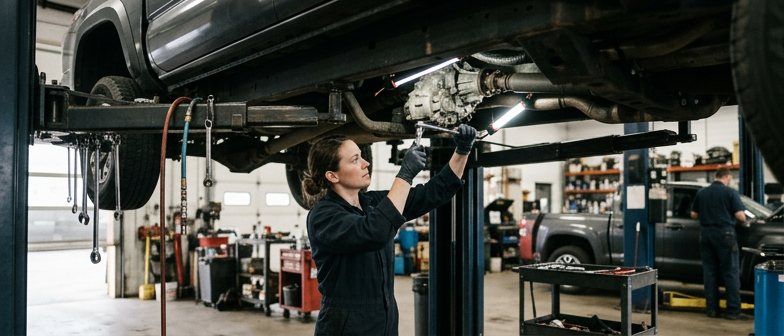
When drivers say their four‑wheel drive will not engage, they usually mean the vehicle stays in two‑wheel drive even after pressing the 4WD button or moving the selector. Instead of feeling a solid shift and extra traction, the vehicle may drive the same, or a 4WD warning light may flash, stay on, or fail to come on. Some drivers notice clicking or clunks, or a brief attempt to engage followed by the system dropping back out of 4WD. These signs often point to problems in the control module, actuators, hubs, or the transfer case, and they often show up when roads are slick or when low range is needed but the vehicle does not respond.
If your 4WD will not work, the vehicle usually still moves in two‑wheel drive, but whether this is safe depends on road conditions and how you drive. On dry pavement at moderate speeds, most vehicles are intended to operate in 2WD, so the main concern is reduced traction rather than sudden mechanical failure. Once you notice the system failing, it is sensible to avoid deep snow, mud, or steep off‑road terrain and to have a mechanic inspect the 4WD system. A workshop that regularly deals with four‑wheel‑drive faults can carry out a structured inspection to identify whether the cause is electrical, mechanical, or due to worn components before suggesting any repair.
If four-wheel drive will not engage, first confirm the vehicle is either in two-wheel drive or fully out of any 4WD mode. Make sure the 4WD switch or lever is firmly set, the transmission is in the recommended gear, and check for flashing warning lights. Stop trying to use 4WD if you notice grinding noises, strong vibration, or burning smells, because forcing engagement can increase damage to the transfer case, hubs, or actuators. Before deciding whether to keep driving, walk around the vehicle, look for leaks near the transfer case or axles, and check that tires and visible suspension and driveline parts look normal.
On paved roads at moderate speeds, many vehicles can be driven safely in two-wheel drive as long as they feel stable and are not making unusual sounds. Avoid deep snow, mud, steep hills, or off-road areas where extra traction would normally be needed, and change your route if you risk getting stuck. If the vehicle pulls to one side, clunks during turns, or feels like the driveline is binding, limit driving and arrange a professional inspection of the 4WD failure to find out whether continuing in 2WD is acceptable or whether towing is the safer choice. Note when symptoms started and any recent repairs to help the technician diagnose the problem.
| Driving condition | Safety level in 2WD with 4WD not engaging | Recommended action | Need 4WD failure inspection near you |
|---|---|---|---|
| Dry paved city roads | Generally acceptable | Drive cautiously, monitor for noises | Low |
| Wet or slick highways | Conditional | Reduce speed, avoid sudden maneuvers | Medium |
| Deep snow or mud | Often unsafe | Avoid route, consider alternate transport | High |
| Steep off-road hills | Not recommended | Do not attempt climb without 4WD | High |
| Vehicle feels unstable or pulls | Questionable | Limit driving, consider towing | High |
| New grinding or burning smell | Unsafe | Stop driving, seek nearby inspection | Highest |
Schedule a 4WD diagnosis when the system will not engage, cuts in and out, shows dash warnings, or starts making new grinding or clunking noises during mode changes. A basic inspection at a general shop or drivetrain specialist usually checks transfer case operation, electronic controls and wiring response, and whether hubs, actuators, and fluids are in acceptable condition. This early evaluation helps separate minor electrical or control faults from internal mechanical damage, so you have a clearer idea of whether the vehicle is reasonably safe to keep driving for now and what kind of repair cost range and possible downtime might be involved before approving major work.
When a four-wheel-drive system will not engage, repair shops focus first on the mechanical parts that switch from two-wheel to four-wheel drive. A frequent source of trouble is the front axle or hub actuator, which locks the front axle or wheel hubs when 4WD is selected. Sticking mechanisms, loss of electrical or vacuum supply, or internal damage can leave the 4WD light flashing without the front wheels engaging. Because actuator designs differ across vehicles, technicians at a local drivetrain or 4WD shop typically inspect wiring, vacuum lines, and the actuator itself before deciding whether parts are available and a repair or replacement is appropriate.
The transfer case is the next major component. This gearbox sends power to front and rear axles and relies on chains, gears, and clutches that must move freely. Wear, contaminated fluid, or mechanical failure here can cause grinding, slow engagement, or a complete inability to switch modes. A shop experienced with transfer cases will usually check for leaks, examine fluid condition, and listen for internal noise to judge if targeted repairs or a full replacement make more sense. Because transfer case work can be expensive, understanding which internal parts failed helps you discuss realistic costs and timing with a nearby specialist.
Modern 4WD systems also depend on electronic control modules and sensors. A dedicated 4WD controller or the main powertrain computer reads dash switches and range or speed sensors, then commands actuators and the transfer case to move. Faults in switches, wiring, or the module can leave the system in two-wheel drive even when indicators appear normal. During diagnosis, technicians use scan tools to look for stored trouble codes, confirm that the control unit is sending signals, and check whether suitable electronic replacement parts are available for the vehicle. Combining these electronic and mechanical checks helps you understand what has failed and what the repair shop is proposing.
In many four wheel drive systems, actuators and hubs physically lock the front axle or shift the transfer case. If an actuator sticks, leaks, loses power, or an automatic hub is worn or full of debris, the dash may show 4WD but the front wheels do not get torque. Shops commonly start with a visual check for damaged wiring, loose connectors, vacuum line issues, or cracked housings, then test actuators and hubs by applying power or vacuum and rotating the wheels to confirm engagement.
Electronic control modules coordinate signals between dash switches, sensors, and the actuators, so a fault here can resemble mechanical failure. A typical control module diagnosis uses a scan tool to read stored trouble codes, watch live data from position sensors, and command 2WD and 4WD while observing actuator response. If commands are incorrect, technicians recheck power and ground circuits and sensor inputs before deciding whether the module needs repair or replacement.
When a four‑wheel‑drive system stops working, drivers usually want a realistic sense of repair costs before authorizing work. Any estimate depends on which part failed, how complex the drivetrain is, and local labor rates. Minor faults such as a damaged connector or simple switch are generally less expensive than internal mechanical problems in the transfer case. Shops also consider whether the issue is common on that vehicle or an unusual fault that could take longer to diagnose.
Work on the transfer case is often one of the larger expenses in four‑wheel‑drive repairs because it directs power to the front and rear axles and contains multiple internal components. The price is influenced by the type of transfer case, whether individual parts can be replaced or the whole unit must be changed, and how difficult it is to access. Repair facilities may quote different figures based on their experience, warranty approach, and use of new, remanufactured, or used units, and labor to remove and reinstall the case can be a major portion of the total.
Parts availability has a direct impact on the final bill. Common external components such as sensors, actuators, and seals are often easy to source and competitively priced, but specialized items for older or low‑volume models may be harder to obtain. Limited stock can mean ordering from distant suppliers or choosing remanufactured parts, which may add time and affect cost. Because of these variables, careful inspection is usually needed before a shop can provide a specific estimate for four‑wheel‑drive or transfer case repair.
What does it usually mean when my 4WD will not engage?
It means the system is staying in two‑wheel drive despite your input. The cause is often in the transfer case, hub or axle actuators, or the 4WD control module and related wiring.
Is it safe to keep driving if my 4WD is not working?
On dry roads, many vehicles can be driven in 2WD if there is no grinding, burning smell, or fluid leak. If you notice noises, vibration, or warning lights, have the driveline inspected before further driving.
When should I ask a repair shop for a 4WD diagnosis before authorizing repairs?
Schedule a diagnosis if 4WD will not engage, drops out, shows dash warnings, or starts making new noises when switching modes. A shop can separate minor electrical issues from internal mechanical damage.
What components will a 4WD repair shop near me typically check first?
Technicians usually start with the transfer case operation, 4WD control module, wiring, and front hub or axle actuators, then confirm fluid condition and look for leaks or obvious mechanical wear.
How do shops estimate the cost of transfer case or 4WD repairs?
Cost depends on whether the fault is external, like switches or actuators, or internal to the transfer case, plus parts availability and local labor rates. A written estimate generally follows the initial inspection.