
x
Faced with rising labor pressure and complex order profiles, many teams wonder if warehouse automation will truly pay off. This feasibility study framework helps you decide, using structured data, technology comparisons such as ASRS vs AMR, integration requirements, budget estimates, and realistic ROI modeling.
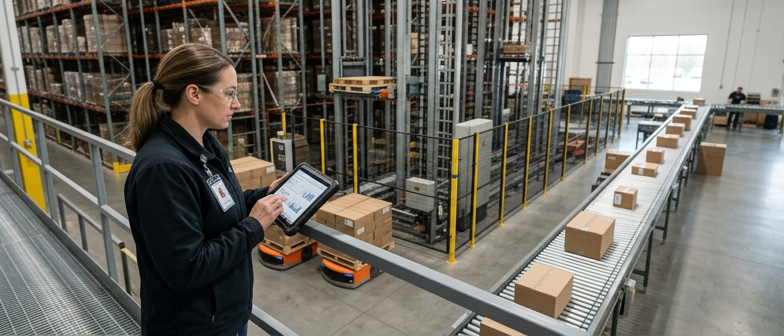
A warehouse automation feasibility study is a structured assessment used to judge whether automation can realistically improve a specific facility’s performance. It translates strategic goals such as higher throughput, fewer errors, or reduced manual handling into measurable criteria and tests automation concepts against those criteria. The study clarifies which operational problems are being addressed, which processes are included, and what operational and financial success would look like. It also defines how detailed the analysis will be, from high level scenarios to more granular design assumptions, so stakeholders understand that the outcome is an evidence based recommendation rather than a prediction of guaranteed results.
In scope, a feasibility assessment typically focuses on cost, risk, and operational impact. It estimates the cost of conducting the study and of potential implementation, outlines a realistic budget range, and highlights drivers such as facility size, order profiles, and integration complexity. The work usually includes risk analysis, covering technical uncertainties, implementation and safety challenges, and change management implications for the workforce. By making these boundaries explicit, the study helps decision makers compare automation scenarios consistently, understand trade offs before committing capital, and decide whether to move to detailed design or adjust their plans to fit financial and operational constraints.
A warehouse automation feasibility assessment depends on a clearly defined data set and analytical approach before specific technologies are evaluated. Key quantitative inputs include historical and forecast order volumes, lines per order, cube and weight profiles, and seasonality to understand throughput over time. Process and labor data such as current pick and pack methods, travel distances, task productivity, overtime usage, and shift patterns show how work is performed today. Space information covers building dimensions, clear heights, dock capacity, storage media, and zoning or safety constraints that may limit automation layouts. Qualitative inputs, including service level expectations, growth plans, potential changes in product mix, and current operational pain points, ensure that automation concepts are measured against real business needs rather than abstract efficiency targets.
Once core data is available, an analytical framework connects operational realities to system design and technology choices. This typically involves material flow and capacity models, bottleneck analysis, and scenarios that compare manual operations with different automation levels. To support return-on-investment modeling, the study needs structured assumptions for equipment and implementation costs, changes in labor and maintenance, effects on error rates, and potential impacts on inventory and service performance. A review of the IT landscape is also required, including existing warehouse management and enterprise resource planning systems, their integration capabilities, and functional gaps that define future WMS needs in an automated environment. Understanding how automated equipment and control systems would interface with these platforms helps reveal integration risks, data standards, and process changes, and provides a traceable basis for selecting options and estimating financial outcomes.
Defining system requirements for warehouse automation starts with translating real order profiles, inventory strategies, and labor patterns into specific functions the WMS and ERP must support. In a feasibility assessment, teams typically document how orders are received, allocated, picked, packed, and shipped, then express these workflows as configuration rules, data fields, and interface needs. The goal is to identify what the WMS must do natively, what can be handled by automation controllers, and where new messages or APIs are required so that automated equipment can receive tasks, report status, and sync inventory updates without disrupting existing financial and planning processes.
A warehouse automation feasibility study usually begins by linking core technologies to order profiles, storage characteristics, and labor constraints. Automated storage and retrieval systems are often compared with autonomous mobile robots because they reflect different design philosophies. High‑density ASRS solutions with cranes or shuttles can increase space utilization and predictable throughput but tend to require building modifications and a stable, well‑defined inventory profile. Mobile robot fleets that move shelves or totes offer more layout flexibility and incremental scaling, yet rely on accurate digital inventory, reliable wireless networks, and carefully managed safety zones for mixed human–robot operations. Comparative analysis focuses on capacity, responsiveness to demand swings, maintenance, and how each option fits long‑term network plans, not just immediate issues.
Conveyors and goods‑to‑person systems form another core decision in detailed design work. Conventional conveyor networks suit stable, high‑volume flows with predictable product paths, simplifying movement between receiving, storage, and packing but creating fixed routes that are harder to adapt when assortments or service levels change. Goods‑to‑person solutions such as shuttle systems, vertical lift modules, or robotic picking concentrate labor at ergonomic stations while equipment brings inventory to the worker. These concepts are evaluated for their impact on picker travel, error rates, peak handling, slotting and cartonization approaches, and for how building height, floor loading, and fire protection constraints may favor one option over another.
Across all technology choices, design studies emphasize how subsystems behave as an integrated whole. Analysts model interactions between storage equipment, transport technologies, and pick stations, and how they connect to warehouse management and enterprise resource planning software, including data quality, interface stability, and exception handling. Scenarios often test hybrid layouts, such as combining mobile robots with selected conveyor segments or embedding goods‑to‑person modules into existing racking to reduce disruption. Trade‑offs are framed around capital and operating cost, resilience to equipment failures, and flexibility for future expansion, so that feasibility conclusions reflect both technical viability and operational sustainability for the specific facility.
| Technology Option | Order Profile Fit | Layout Flexibility | Design & Integration Complexity | Risk & Expansion Considerations |
|---|---|---|---|---|
| ASRS | Stable, high-volume, repeatable orders | Low, fixed aisles and structures | High, requires building changes and tight WMS integration | High capital commitment, strong for planned long-term growth |
| AMR Systems | Variable orders with changing SKUs | High, reconfigurable paths and zones | Medium, depends on digital inventory and wireless reliability | Incremental scaling, sensitive to network and safety management |
| Conveyor Networks | High-throughput, predictable process flows | Low, fixed routes between work areas | Medium, mechanical design and controls coordination | Stable once installed, less adaptable to shifting service levels |
| Goods-to-Person Solutions | Mixed order sizes with labor concentration needs | Medium, constrained by building height and floor loading | High, integrates storage, picking stations, and WMS rules | Efficient for peaks, requires careful slotting and fire protection review |
| Hybrid Layouts (ASRS/AMR + Conveyors/GTP) | Sites with diverse profiles and phased automation plans | Medium to high, targeted automation zones | High, multiple subsystems and interface handling | Balanced flexibility and resilience, depends on robust scenario modeling |
Comparative assessments begin with a common framework for all technologies, typically including automated storage and retrieval systems, autonomous mobile robots, conveyors, and goods-to-person solutions. A single baseline scenario is defined around current operating needs, then each option is modeled against that scenario to quantify capacity, space use, flexibility, energy consumption, labor requirements, integration effort, and qualitative factors such as maintenance demands and workforce impact.
A warehouse automation feasibility study builds a clear view of total investment, including equipment, software, integration, construction, and change management. It separates one‑time capital expenditure from ongoing costs such as maintenance, support, energy, and changes in labor. Based on this cost breakdown, the team prepares a budget estimate tied to project scope, implementation phases, and contingency allowances. The analysis also looks at indirect financial effects, such as changes in error rates, throughput, and service levels, and how these may influence operating costs or revenue under different demand patterns.
Feasibility work usually includes structured ROI modeling and risk analysis so the numbers can support decisions. Financial models project multi‑year cash flows and calculate indicators such as payback period, net present value, and internal rate of return, then use sensitivity tests to show how results vary with different volumes, labor rates, or technology performance. Comparing scenarios, for example a highly automated concept versus a more incremental approach, helps clarify trade‑offs between investment size, flexibility, and exposure to risk. Risk assessment examines potential disruption, technology obsolescence, integration challenges, and regulatory or safety issues, treating them as factors to be mitigated rather than simple barriers to automation.
What is the main purpose of a warehouse automation feasibility study?
It tests whether automation can realistically improve service, throughput, costs, and safety in a specific facility before any design or investment decisions are made.
What data is typically needed to evaluate automation options?
Teams use order and inventory profiles, seasonality, process times, labor and shift data, layout and building constraints, plus service level targets and growth plans.
How are WMS and ERP requirements defined for automation integration?
Current workflows for receiving, allocation, picking, packing, and shipping are mapped into rules, data fields, and interfaces so equipment, WMS, and ERP can exchange tasks and inventory updates reliably.
How does an ASRS compare with AMRs in warehouse design studies?
ASRS usually offers high‑density storage and stable, predictable throughput but needs fixed layouts, while AMRs provide flexible, scalable capacity with more reliance on digital mapping and mixed human–robot operations.
How is cost and ROI modeled in an automation feasibility assessment?
Analysts estimate capital and operating costs, model scenarios for error reduction, labor changes, and throughput, then compare financial outcomes against a budget and risk assumptions.