
x
When you need to choose or budget a Vertical Grinding Mill for a line expansion, questions about cost, capacity, and fineness quickly arise. This overview helps you weigh vertical mills against Raymond mills, estimate installed and maintenance costs, and manage vibration and wear risks.
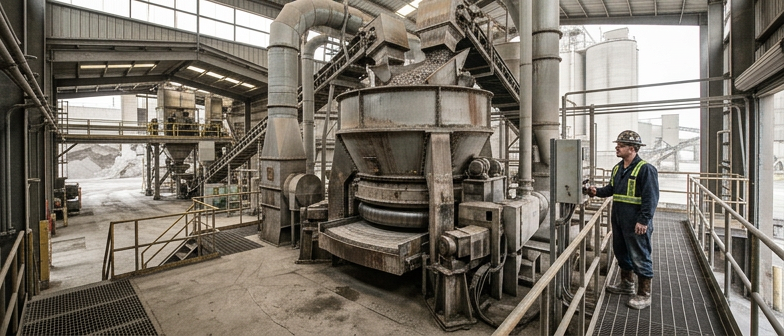
A vertical grinding mill is an integrated comminution unit that aligns the grinding chamber, classifier, and drive on a vertical axis. Feed enters near the center and passes through a bed of media or rollers, where size reduction occurs before an internal classifier separates fine product from coarse material. Because classification is built into the same housing, recirculation outside the mill is limited, floor space requirements are modest, and product fineness can be controlled with relative precision. These features make vertical mills common in cement, mining, industrial minerals, and power generation when consistent quality and predictable operating costs are priorities.
When facilities assess mill choice for a new installation or line expansion, vertical mills are often evaluated against traditional Raymond mills. Engineers typically compare achievable capacity at the required fineness, specific energy use, and the ability to handle moist feed or incorporate drying. Vertical designs can offer high throughput in a single machine and a compact layout, whereas Raymond mills are frequently selected for smaller duty or narrow product ranges. Modern comminution planning therefore considers how each option fits into the process flowsheet, including access for maintenance, expected wear behavior, and flexibility to adjust capacity or products over the life of the plant.
Cost comparison between vertical grinding mills and Raymond mills usually considers the full life cycle rather than only the purchase price. Vertical mills often need higher upfront investment because of larger assemblies, stronger foundations, and auxiliary systems such as gearboxes and hydraulics. This tends to raise the installed cost, including structural work, access platforms, and ducting. In return, a vertical mill can combine drying, grinding, and classification in one unit and often runs with lower specific energy use, which may reduce the number of separate machines and some installation effort. Raymond mills are typically simpler to erect, fit into smaller buildings, and are frequently chosen where space is limited or the target capacity increase is modest.
In operation, vertical mills are commonly selected for higher throughput and finer product, and they usually cope better with variations in feed moisture and hardness, which is important for long term capacity planning and line expansions. Their economics are strongly influenced by wear of rollers and liners, so plants track wear rates and plan liner replacement to control downtime and periodic costs. Raymond mills have a simpler internal layout and individual spare parts may be less expensive, but they can become less energy efficient at very high capacities or require multiple units to reach the same output. The overall decision therefore weighs initial and installed cost, expected spending on wear parts such as mill liners, energy use per ton, and the capacity and fineness required over the planned production horizon.
| Mill Type | Typical Capacity Range | Energy Use Per Ton | Maintenance Intensity | Installed Cost Drivers |
|---|---|---|---|---|
| Vertical grinding mill | High throughput, line expansion | Lower, especially with drying | Higher focus on rollers and liners | Heavy foundations, structural work, hydraulics |
| Raymond mill | Moderate throughput, smaller upgrades | Higher at very large loads | Simpler layout, lower part complexity | More compact buildings, simpler erection |
| Vertical grinding mill | Stable under variable feed | Integrated drying and classification | Planned liner replacement schedules | Access platforms, ducting, auxiliary gearboxes |
| Raymond mill | May require multiple units for growth | Can suit modest capacity increases | Frequent but simpler wear part changes | Lower initial investment, reduced civil works |
Installed cost for a vertical grinding mill is strongly influenced by civil and structural works. Foundations, building modifications, and access platforms must handle the mill’s weight, height, and vibration, and brownfield sites often need more complex adaptation. Containerized or other preassembled designs can shorten on‑site construction and labor, but they still depend on suitable pads, anchoring, and adequate space in the existing process line.
Electrical and process integration also shape the overall investment. Drives, starters, and transformers have to match the mill power demand, and plant distribution systems may need reinforcement when equipment is replaced or upsized. On the process side, ducting, feeders, classifiers, and product collection equipment must fit the target fineness and throughput, and the degree to which existing infrastructure and access for liner and roller maintenance can be reused affects both initial cost and long‑term expense.
When planning a production line expansion, mill selection starts with defining required capacity, target fineness, and product consistency. Vertical grinding mills usually handle higher throughputs and keep more stable performance when feed moisture, hardness, or particle size fluctuate, which suits larger upgrades or new plants. Raymond mills are often used for moderate capacity, simpler layouts, or sites where space and upfront investment must be tightly managed. Engineers compare not only nameplate capacity but also how each design responds to variations in feed properties, because these factors often determine real output, energy use, and reliability over the life of the line.
Target fineness is equally important, since the chosen mill must reach the specified particle size without excessive energy or maintenance cost. Vertical mills generally offer wider adjustment of product fineness and integrated classification that helps achieve narrow size distributions in cement, mineral, and other powder applications. Raymond mills can be appropriate when the required fineness is in a conventional range and the material is relatively easy to grind. A structured comparison looks at whether the mill can reach the target fineness without high recirculation load, whether there is practical room to increase capacity later, and how easily settings can be tuned when product specifications change, so the expanded line remains adaptable.
To achieve a target fineness in a vertical grinding mill, engineers adjust the classifier and grinding pressure within the supplier’s recommended limits. A faster, sharper classifier sends more coarse particles back to the table, producing finer product but usually lowering capacity and raising energy use. Grinding pressure must be high enough to reach the required particle size without overloading the bed or causing excessive wear. Mill settings are therefore chosen from the desired size distribution, not from extreme fineness targets that would reduce stability and equipment life.
Feed characteristics determine how close the mill can run to these settings. Very fine or moisture‑sensitive feed can disturb the grinding bed, weaken inter‑particle compression, and create vibration or unstable differential pressure. Before operation, feed size, moisture, and any pre‑grinding are adjusted so the bed stays compact at the selected pressure and classifier load, with vibration monitoring used to fine‑tune the operating point over time.
Reliable operation of a vertical grinding mill depends on disciplined inspection routines focused on fastening, wear parts, and operating behavior. Bolts on the housing, base, and access doors should be checked and retorqued at defined intervals to prevent misalignment, vibration, and safety risks. The liner system needs a documented replacement schedule based on operating hours, feed abrasiveness, and observed wear. Planning liner changeouts in advance allows maintenance teams to estimate labor needs, shutdown duration, and the likely cost of parts, internal access equipment, and lost production during the outage.
Grinding rollers, table segments, and other internal components should be inspected visually and dimensionally to assess wear patterns and avoid uneven loading that could destabilize the grinding process. Operators need to track changes in vibration, especially when feed becomes finer or more variable than the design range. Very fine feed can reduce the stability of the material bed and allow mechanical vibration to build, so adjustments to feed rate, classifier settings, or moisture may be required. Recording vibration trends, torque, and temperature alongside maintenance actions helps refine the preventive schedule and supports safer, more predictable vertical mill performance.
How does a vertical grinding mill integrate grinding and classification?
Feed passes through the grinding zone and straight into an internal classifier, which returns coarse material to the table and allows fines to leave as product, reducing external recirculation.
When comparing vertical mill and Raymond mill cost, what should engineers focus on?
They usually compare total installed and lifecycle cost, including foundations, building changes, energy use, maintenance, and achievable capacity, not only the purchase price.
How is the installed cost of a vertical mill typically estimated?
Estimates combine the mill package with civil works, structural steel, access platforms, ducting, utilities, and commissioning, with brownfield modifications often dominating the budget.
What maintenance checks help prevent vibration in a vertical mill?
Regularly verify and retorque critical bolts, monitor grinding roller and liner wear, and investigate fine or unstable feed that can disturb the material bed and increase vibration.
How do operators select settings to reach a target fineness in a vertical mill?
They adjust classifier speed and grinding pressure within safe limits, balancing finer product against lower throughput, higher energy use, and faster wear of rollers and liners.