
x
Whether you are new to spray drying or moving from lab trials to full‑scale production, understanding the spray drying process helps you control particle size, limit wall buildup, and judge costs by volume so powders meet performance, stability, and scale‑up requirements.
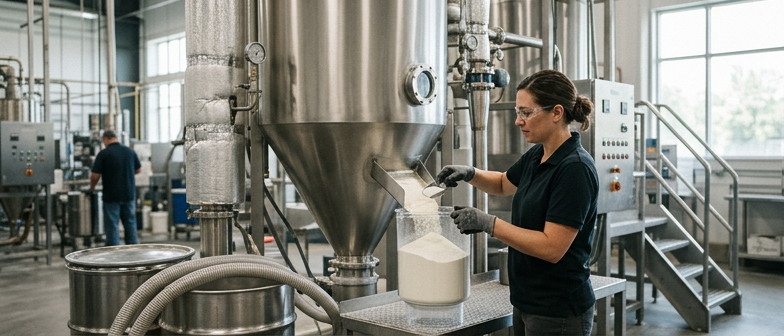
The spray drying process turns a liquid feed into a dry powder in a single, continuous step. A pump moves a liquid or slurry containing dissolved or suspended solids to an atomizer, which breaks the feed into fine droplets. These droplets contact hot drying gas, usually air, inside a chamber. Because the droplets are small, moisture evaporates quickly and solid particles form in flight. Cyclones, bag filters, or similar equipment then separate the dried particles from the air to produce a free‑flowing powder that can be stored, blended, or further processed. For beginners, it is useful to view spray drying as three linked stages: preparing the feed, creating droplets, and removing moisture while collecting the final powder.
Reliable operation depends on suitable raw material properties. The liquid feed should have a stable composition and a solids content high enough for efficiency but low enough to remain pumpable. Viscosity needs to be controlled so the feed can pass through the atomizer and form uniform droplets, and the material should not form large clumps or settle rapidly, which can cause uneven drying. Many formulations require homogenization, dissolution, or emulsification to distribute ingredients evenly. It is also important to understand how the material behaves at elevated temperature, including risks of thermal degradation, stickiness, or browning, so that inlet and outlet air temperatures can be chosen to protect product properties while still achieving effective drying.
A spray drying process uses coordinated equipment to convert a liquid feed into a dry powder. The feed tank, pump, and filters prepare and deliver the solution or suspension to the atomizer with controlled flow and cleanliness, which supports stable droplet formation. Atomizers may be pressure nozzles, two‑fluid nozzles, or rotary wheels, each creating a characteristic droplet size range. These droplets enter a drying chamber where heated air is introduced in co‑current, counter‑current, or mixed flow, selected during process development to match product needs. The chamber connects to a cyclone or baghouse for powder collection and to an exhaust system that maintains airflow, removes moisture, and helps meet safety and environmental requirements. How these elements are configured influences product quality, yield, and the tendency for material to accumulate on dryer walls.
Within this layout, operating parameters are the main tools for guiding particle size and process stability. Inlet and outlet air temperatures set the driving force for evaporation, shaping residual moisture, heat exposure, and risks of thermal degradation. Airflow rate and chamber pressure influence residence time and flow patterns, affecting particle trajectories and wall deposition. Atomizer pressure, gas assist rate, or wheel speed are key levers for adjusting droplet size and the resulting particle size distribution and bulk density. Feed solids content and viscosity control how easily the liquid atomizes and how quickly it dries, so they are tuned to balance efficiency with the risk of incomplete drying or buildup. Even modest changes in these variables can alter wall fouling, powder handling, and overall performance, so laboratory spray drying trials and scale‑up studies rely on systematic testing and monitoring.
| Operating Parameter | Impact on Particle Size | Impact on Moisture Content | Impact on Wall Buildup | Typical Use in Process Development |
|---|---|---|---|---|
| Inlet air temperature | Indirect control via drying rate | Strong influence; lower to retain moisture | High setting can increase stickiness risk | Defining safe thermal window |
| Outlet air temperature | Associated with residence time | Key indicator of final dryness | Too low can promote wet adhesion | Monitoring endpoint of evaporation |
| Airflow rate and chamber pressure | Moderate effect via residence time | Influence uniformity of drying | Flow maldistribution increases deposition | Tuning flow patterns for stability |
| Atomizer pressure / gas rate / wheel speed | Primary lever; higher energy gives smaller particles | Indirect effect through surface area | Very fine droplets may raise fouling tendency | Balancing size distribution and bulk density |
| Feed solids content | Higher solids promote larger particles | Lower solids dry more readily | Very concentrated feeds can raise buildup | Optimizing efficiency versus dryness risk |
| Feed viscosity | High viscosity tends to coarser droplets | Can slow internal moisture removal | Poor atomization increases wall contact | Adjusting formulation for stable atomization |
Particle size in spray drying is controlled by how the feed is atomized and dried. Higher atomization energy, smaller nozzle orifices, and lower viscosity produce finer droplets and smaller particles. Higher solids content and gentler drying favor larger, more porous particles and allow some control over bulk density. Adjusting these variables together helps match particle size distribution and packing behavior to the intended use of the powder.
Powder flow and reconstitution depend on surface composition, internal structure, and residual moisture. Carriers, emulsifiers, and stabilizers can limit stickiness, improve handling, and support uniform wetting during mixing or rehydration. Drying temperature and outlet humidity shape whether particles form smooth or porous surfaces, which affects caking, dust generation, and solubility, so process development usually relates operating conditions to flowability, density, and dissolution time.
Laboratory spray drying is often the first structured step in turning a powder idea into a workable process. Bench and pilot units allow teams to test feed composition, atomization method, inlet and outlet temperatures, and air flow using small solution volumes. Typical workflows start by defining product targets such as moisture, solubility, flavor retention, or particle size. Formulators prepare candidate feeds, sometimes with Design of Experiments to vary solids content, carrier systems, and viscosity, and run short trials to see how easily each feed dries, how much wall buildup occurs, and how stable the powder remains in storage. Independent laboratories, including facilities near research hubs such as Wayzata, can provide contract trials when internal spray drying equipment or experience is limited.
Moving from these early trials to full process development means linking laboratory observations to production scale equipment. Engineers use scale up tools such as dimensionless numbers, air to feed ratios, and dryer geometry, and they compare lab particle size and moisture data with results from larger chambers. Modern process development often applies analytical instruments and modeling to predict how changes in nozzle type, atomization pressure, or gas flow influence powder properties and energy use. Because lab dryers rarely reproduce residence time, internal circulation, or heat and mass transfer conditions found in industrial units, results need cautious interpretation and confirmation in pilot or demonstration plants. Differences in atomizers, cyclone performance, and control systems make laboratory work most suitable as a screening and learning stage rather than a complete representation of the final spray drying process.
Reliable scale-up of a spray drying process depends on how well the feed has been characterized at the laboratory stage. For liquids and slurries, solids content, viscosity, density, and surface tension are documented because these properties drive atomization behavior and dryer load. Thermal stability and sensitivity to oxygen or light define safe inlet and outlet temperatures and whether inert gas or special handling is appropriate. Particle formation is influenced by dissolved versus suspended solids, crystallinity, and glass transition temperature, which together determine stickiness and the risk of wall buildup. Hygroscopicity and expected shelf life guide target residual moisture and packaging choices, while grade specifications, contaminants, and relevant standards must be known early so that pilot and production equipment, cleaning procedures, and documentation align with quality and compliance.
The economics of a spray drying process are shaped by throughput, energy use, and equipment utilization. For a given formulation, cost per unit volume usually falls as production volume rises, because fixed expenses such as labor, depreciation, and testing are spread over more product. However, higher feed rates push the dryer toward thermal and airflow limits, so operators balance target moisture, particle size, and yield against fan capacity, inlet air temperature, and atomization energy. Modern practice relies on tracking indicators like energy used per pound of water evaporated, recovery in cyclones or bag filters, and the fraction of off-spec material that must be reworked or discarded. Routine review of these data helps define operating windows that meet quality requirements with controlled fuel and electricity use.
Cleaning demands and fouling behavior add significant cost and affect day-to-day decisions. Product buildup on chamber walls and ducting reduces heat transfer, distorts airflow, and can lead to contamination or scorched deposits if not removed in time. To limit buildup, developers consider feed solids content, viscosity, thermal sensitivity, and droplet trajectories created by the atomizer and air distributor. Adjusting inlet and outlet temperatures, refining nozzle or wheel settings, or modifying formulation to improve glass transition behavior can reduce adhesion and extend intervals between cleaning. Fewer shutdowns for manual or clean-in-place procedures increase available production hours and lower labor needs, but any change must be checked carefully to confirm that product safety and regulatory specifications remain satisfied.
What are the basic stages in the spray drying process for beginners?
Spray drying has three main stages: preparing a stable liquid or slurry feed, atomizing it into fine droplets, and drying those droplets in hot gas while separating and collecting the resulting powder.
Which operating parameters most strongly control spray‑dried particle size?
Particle size is mainly driven by atomizer type, nozzle orifice and pressure, feed viscosity and solids content, and the drying air conditions that determine how fast moisture is removed.
How can I reduce wall buildup inside a spray dryer?
Operators typically lower stickiness by adjusting solids content and inlet temperature, select co‑current air flow, optimize atomizer position, and use smooth, insulated chamber surfaces with appropriate cleaning intervals.
What role do laboratory spray drying trials play in process development?
Lab and pilot trials let teams screen feed formulations, atomization methods, and temperature profiles using small volumes, so they can identify drying behavior, wall deposition trends, and target powder properties before scaling up.
Which raw material properties are critical for reliable spray drying scale‑up?
Key properties include solids content, viscosity, density, thermal and oxygen stability, glass transition temperature, hygroscopicity, and required quality specifications, all documented so larger dryers can be designed and operated consistently.