
x
If you’re comparing robotic versus traditional knee replacement or wondering whether your severe arthritis makes you a candidate, this guide helps you understand how robotic systems work, when total or partial robotic surgery is considered, and what questions to ask a specialist before choosing this option.
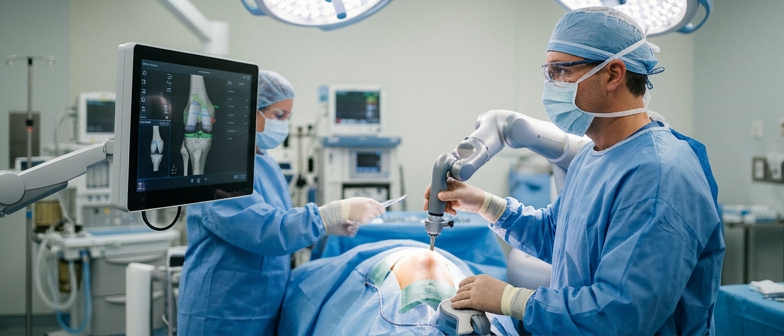
Robotic knee replacement is a surgeon-led knee arthroplasty that uses computer-guided robotic assistance to plan and perform the procedure with highly precise alignment and implant positioning. The system maps the knee in three dimensions and guides bone cuts based on a detailed preoperative plan, while the surgeon remains in control. When comparing robotic versus traditional knee replacement, the main distinction is not the implant itself but how accurately it can be positioned and how reliably soft tissues can be balanced. People with severe arthritis affecting most of the knee may be offered robotic total knee replacement, whereas those whose damage is limited to a single compartment may be considered for a robotic partial knee replacement. The choice between a full or partial robotic procedure depends on how many parts of the joint are worn, overall health, and the surgeon’s judgment.
Many patients are interested in robotic techniques because they offer more individualized implant positioning that may improve knee function and satisfaction for some people, although long-term results are still being studied and are not guaranteed. Robotic total knee replacement is typically considered when cartilage loss is advanced, pain is ongoing, and other treatments such as medications, bracing, or injections no longer help enough. A robotic approach to partial knee replacement can be used when arthritis is confined to one area and ligaments remain stable, aiming to preserve more natural bone and tissue. These robotic options do not replace standard surgery but add another set of tools experienced knee surgeons can use. Knowing how robotic systems assist with planning, execution, and soft-tissue balance can help patients discuss which type of knee replacement matches their arthritis pattern and activity goals.
| Approach | Best Fit Arthritis Pattern | Soft‑Tissue Balance Precision | Bone and Tissue Preservation | Typical Patient Priority Match |
|---|---|---|---|---|
| Robotic Total Knee Replacement | Severe, multi‑compartment disease | High, computer‑guided adjustments | Lower, more bone removed | Relief of widespread pain and deformity |
| Traditional Total Knee Replacement | Moderate to severe, broad involvement | Moderate, surgeon manual judgment | Lower, similar to robotic total | Established method with predictable technique |
| Robotic Partial Knee Replacement | Single‑compartment wear with stable ligaments | High, targeted compartment planning | Higher, preserves more native structures | Maintaining more natural knee feel and motion |
| Traditional Partial Knee Replacement | Localized damage, clear compartment limits | Moderate, relies on visual landmarks | Higher, focused resurfacing only | Quicker recovery focus with familiar tools |
Robotic versus traditional knee replacement mainly differs in how the operation is planned and executed, not in the overall goal of replacing damaged joint surfaces. In a conventional procedure, the surgeon relies on standard guides, manual instruments, and visual landmarks to align and place the implants. Robotic-assisted knee surgery starts with detailed imaging and computer planning to create a three-dimensional model of the knee, helping the surgeon fine‑tune alignment and ligament balance. During a robotic procedure, the surgeon still makes all clinical decisions and controls the tools, while the system limits cutting outside the planned area to enhance precision. Research indicates robotic systems can reduce some alignment errors and may benefit selected patients, but long‑term results for pain relief, function, and implant survival are broadly similar to well‑performed traditional knee replacement. Because outcomes depend heavily on the orthopedic surgeon’s skill and judgment, the choice between robotic and conventional techniques is usually based on surgeon expertise, knee condition, and patient preference after an honest discussion of realistic pros and cons.
When people wonder whether they are candidates for robotic knee surgery, surgeons focus on the type and severity of arthritis and how much it limits daily life. Robotic knee replacement for severe arthritis is usually discussed when cartilage loss leads to ongoing pain, stiffness, and loss of mobility despite non-surgical treatment such as activity changes, physical therapy, weight control, medications, or injections. Robotic assistance does not change the basic goal of knee replacement, but it can help with more precise planning of bone cuts and implant position, which may be useful when the joint is deformed or the anatomy is complex.
Some individuals are better suited to a full robotic knee replacement, while others may qualify for a robotic partial knee procedure that resurfaces only the most damaged compartment of the joint. Partial surgery is considered when arthritis is clearly limited to one area, ligaments are intact, and symptoms match what appears on X-rays or other imaging. Overall health, bone quality, body weight, and the ability to participate in rehabilitation are also important, and surgeons weigh the potential advantages of robotic guidance against these broader medical factors rather than relying on imaging alone.
Robotic knee surgery is typically considered after conservative measures, including injections, no longer provide lasting relief. If you have had repeated cortisone or other knee injections with only short-term benefit, your surgeon may talk with you about moving from injections to a robotic-assisted knee replacement. The decision is individualized and depends on a detailed exam, imaging, and review of your medical history, medications, and expectations for recovery, rather than a single test or checklist.
Robotic knee replacement is usually considered only after other treatments, such as medications, activity changes, weight management, physical therapy, and joint injections, no longer give enough relief. When injections have failed to control pain or stiffness, your orthopedic surgeon may talk with you about whether robotic knee surgery is appropriate, especially if imaging shows advanced joint damage and severe arthritis. Robotic assistance does not change the fact that it is a major operation, but it can help the surgeon plan bone cuts and implant positioning more precisely, which may be useful when the knee has already been through many non‑surgical therapies.
When searching for robotic knee replacement surgeons, focus less on who is closest and more on who is best qualified for your condition. Look for orthopedic surgeons with joint replacement fellowship training and specific experience on robotic platforms. A strong surgeon regularly performs robotic-assisted procedures, can explain when a robotic partial knee replacement is appropriate versus a full replacement, and can clearly discuss whether robotic technology fits your anatomy, arthritis pattern, and overall health. Instead of relying only on the idea of robotic knee surgeons near you, pay attention to board certification, the hospital’s reputation, access to a coordinated care team, and the surgeon’s ability to review risks, benefits, and alternatives.
Before choosing a surgeon, prepare key questions to ask about robotic knee surgery so you can compare options. Ask how many robotic knee replacements they perform each year, how they decide between robotic and traditional techniques, and what their outcomes and complication rates are. Clarify whether robotic knee replacement is recommended for your stage of arthritis and how they approach cases after failed injections or other non-surgical treatments. Make sure you understand expected recovery milestones and long-term function. A thoughtful surgeon will welcome your questions, set realistic expectations, and emphasize that robotic systems improve precision but do not guarantee perfection, helping you base your decision on trust and expertise rather than simple proximity.
When you meet with an orthopedic surgeon about robotic knee replacement, bring written questions so you can make an informed choice. Ask how robotic assistance changes accuracy and alignment compared with traditional knee replacement, and whether that actually improves pain relief or function for people with severe arthritis. Find out if you are a good candidate based on your age, weight, activity level, health conditions, and whether you need a total or partial knee replacement. Ask how failed nonsurgical treatments such as injections or physical therapy might affect your surgery plan and expected recovery time. Finally, discuss the main risks and complications, how long the implant is likely to last, and what realistic activity goals and limitations you should expect after surgery so you understand the real benefits and trade‑offs of a robotic approach.
How does robotic knee replacement differ from traditional surgery?
Both replace damaged joint surfaces, but robotic systems use 3D planning and guided tools to help the surgeon place implants and balance soft tissues more precisely. Results still depend mainly on surgeon skill and your overall health.
Am I a candidate for robotic knee surgery if I have severe arthritis?
You may qualify if arthritis causes daily pain, stiffness, and limited walking despite exercise, medicines, weight control, or injections. An orthopedic joint‑replacement specialist must confirm the diagnosis and whether total or partial robotic replacement fits your knee.
Can robotic knee surgery be an option after injections have failed?
Yes. It is often considered when injections, physical therapy, and other non‑surgical care no longer control symptoms and imaging shows advanced damage. It remains major surgery and is offered only after careful discussion of risks and expected benefits.
How should I choose a robotic knee replacement surgeon near me?
Look for a board‑certified orthopedic surgeon with joint‑replacement or arthroplasty fellowship training and frequent experience with robotic platforms. Ask how often they perform robotic partial and total knee replacements and where they completed their training.
What key questions should I ask before robotic knee replacement?
Ask why a robotic approach is recommended for you, whether partial or total replacement is planned, expected recovery time, main risks and complications, implant life expectancy, and what daily or sports activities you can realistically return to afterward.