
x
If you’re eyeing a buy here pay here lot because of bad credit or tiny savings, you need to know how in‑house financing really works. This guide compares down payments from $0–$500, typical approval requirements, real prices, and payments so you don’t overpay.
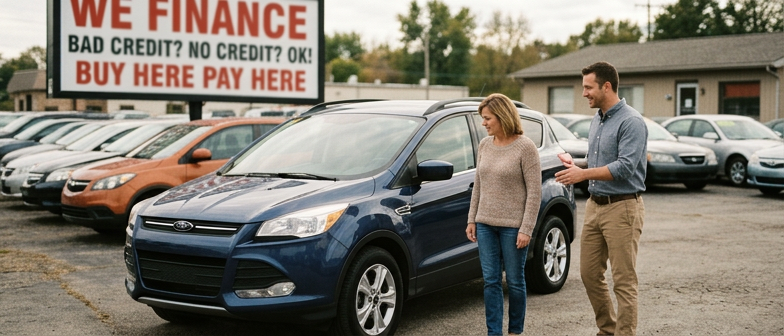
Buy here pay here used car dealers are lots that sell you a vehicle and also finance it themselves, instead of sending you to a bank or credit union. The dealership is both seller and lender, so you sign the sales contract and finance agreement in one place, usually with faster approval and less attention to your credit score. When shoppers search for buy here pay here dealerships near them, they are usually looking for this in-house financing because they have no credit, damaged credit, or have been turned down for a traditional auto loan. In this setup, the dealer decides who qualifies, sets the interest rate and fees, and controls the payment schedule, which can feel simpler but makes it important to look closely at the total cost.
With a conventional car purchase, you agree on a price and then apply for a loan through a bank or finance company that reviews your credit, income, and debt. In a buy here pay here model, the lot uses its own criteria, may focus mainly on your income, and can approve you based on your ability to make frequent payments. Payments are made directly to the dealership, sometimes weekly or biweekly, and may need to be made in person or through a specific portal. This flexibility and local control help more buyers get into a car, but it also affects buy here pay here prices, which are often higher once you add interest, fees, and shorter terms, so you should compare the total amount you will pay over time.
Most buy here pay here dealerships care more about your ability to pay than a strong credit score, but they still have basic approval requirements. You are usually asked for a valid driver’s license, proof of income such as recent pay stubs or bank statements, proof of residence like a utility bill or lease, and several personal references. Some lots also require proof of insurance before you drive away. Even when they advertise light or no credit checks, the dealer may still review your history to decide how much to finance, what interest rate to charge, and which cars you can choose.
The way buy here pay here down payments are handled is central to how these deals are structured. Because the dealer finances the car, it sets the upfront cash needed and may promote low money down options. A down payment can range from a few hundred dollars to a much larger share of the vehicle price, depending on your income, job stability, and the car’s age and mileage. Very low or no money down offers are less common and usually come with higher overall prices, more limited vehicle choices, or steeper finance charges to offset the risk to the dealer.
Ongoing buy here pay here monthly payments are often scheduled to line up with your paycheck and may be weekly or biweekly instead of once a month. The dealer sets the payment based on the selling price, interest, and the length of the contract, then may adjust it after reviewing your budget so it stays within a slice of your take home pay. Because buy here pay here prices and interest rates are often higher than with bank or credit union loans, the contract can feel affordable in the short term but cost more overall, so it is important to read every line, total all payments, and make sure the structure fits your income for the full term.
| Checklist Item | Why It Matters | What To Prepare |
|---|---|---|
| Proof of identity | Confirms legal ability to drive | Valid driver’s license |
| Proof of income | Shows ability to handle payments | Recent pay stubs or bank statements |
| Proof of residence | Helps verify stability and contact | Utility bill or lease document |
| Insurance details | Protects vehicle and lender interest | Current or pre-approved auto insurance info |
| Personal references | Gives dealer backup contact options | Names and phone numbers of trusted contacts |
| Budget snapshot | Aligns payment schedule with paydays | Take-home pay and regular expense list |
When a buy here pay here dealer advertises $0 down, you may be able to sign and drive without cash that day, but the down payment often shows up in other ways. It can be rolled into the total amount financed, which raises overall Buy Here Pay Here prices and your Buy Here Pay Here monthly payments, or appear as fees, insurance costs, or a delayed first payment. A clearly disclosed Buy Here Pay Here down payment makes it easier to see what you invest upfront versus what you pay over time.
Low cash offers such as Buy Here Pay Here $500 down sit between $0 down specials and larger upfront requirements. Putting a few hundred dollars down can slightly lower the payment and show commitment, but many lots still charge higher rates and markups. Before choosing between $0 down and a small down payment, compare the total price, interest, payment schedule, and contract length.
When you work with buy here pay here used car dealers, the starting point is the vehicle price, but that number is only one piece of what you really pay. Dealers set their own Buy Here Pay Here prices, often higher than traditional lots because they take on more credit risk and handle the financing themselves. On top of the sticker price you may see fees for reconditioning, document processing, or add-ons like service contracts, all of which raise the amount that gets financed and increase the total cost of the car.
Your payment schedule is the next big factor. Many Buy Here Pay Here monthly payments are actually due weekly or every other week, timed to your paycheck. Smaller, more frequent payments can feel manageable, but high interest or finance charges can still add thousands over the life of the loan. Missing payments can trigger fast late fees or repossession, and those extra charges are added to your balance, pushing the cost above what the vehicle is really worth.
Compared with more traditional financing through a bank or credit union, the same vehicle may carry lower rates and different terms, so less of each payment goes toward finance charges. With in-house financing at a Buy Here Pay Here dealership, the convenience of easier approval often means higher prices and steeper finance charges in the contract. Before you sign, compare the total of all payments, fees, and interest from different lenders so you understand the real cost of buying this way.
One of the main advantages of working with Buy Here Pay Here used car dealers is access: they often approve buyers with poor or limited credit, steady but modest income, or past repossessions. The best Buy Here Pay Here dealerships may also keep paperwork simple, line due dates up with your payday, decide quickly, and sometimes include basic warranties or the chance to trade up after a stretch of on-time payments.
The trade-off is that Buy Here Pay Here prices and total costs are usually higher than with bank or credit union loans, and inventory is often smaller and older. Because the dealer is also the lender, missed payments can lead to fast repossession, sometimes using GPS or starter-interrupt devices, and your legal protections may be narrower. Not every lot reports to credit bureaus, so on-time payments might not help your score, making it essential to compare offers and read every finance term closely.
When you start looking for Buy Here Pay Here dealerships near you, list every lot within a reasonable drive and note how long each has been open. Focus on stores that look like some of the best Buy Here Pay Here dealerships in your area, with a professional website, clear inventory, and sample contracts that explain their in-house financing. Compare the bold approval promises with the fine print so you can spot offers that sound too easy or depend on vague language.
Then compare each dealer’s Buy Here Pay Here requirements and payment terms so you understand how they will affect your budget. Ask what income documents they accept, whether they need proof of residence and references, and how often they report your account to the credit bureaus. Review how their Buy Here Pay Here monthly payments work, including how often you pay, any late fees, and whether you must pay at the lot. A dealer that can show you the full price of the vehicle and how every payment is applied is safer than one that only talks about a low weekly number.
Before you sign anything, read online reviews, check complaints with consumer agencies, and search court records for patterns of repossessions or surprise fees tied to the dealership. Have the dealer walk you through the entire contract and make sure every promise matches the written Buy Here Pay Here requirements, including interest rate, total of payments, and any extras you are paying for. If anyone rushes you, refuses to let you review the paperwork at home, or gets defensive when you question the Buy Here Pay Here monthly payments, treat that as a warning and be ready to leave.
What does a buy here pay here dealership do?
It sells you a used car and finances it on the lot, so you make payments directly to the dealer instead of a bank, usually with easier approval but higher total cost.
What are the usual buy here pay here requirements to get approved?
You typically need a valid driver’s license, proof of income and address, several references, and often proof of insurance. Your ability to pay matters more than credit score.
How do low down payment deals like $0 down or $500 down work?
When the down payment is small, more of the price and fees get financed, which can raise the total price, interest charges, and monthly or weekly payments versus paying more upfront.
How are payments and overall prices set at buy here pay here used car dealers?
They start with the sticker price, add fees and any add‑ons, apply a high interest rate, then use a short term with frequent payments, so the total paid is often much higher.
How can I compare the best buy here pay here dealerships near me?
Read online reviews, check sites for clear prices and sample contracts, ask if they report to credit bureaus, and avoid lots that hide fees or refuse written terms.