
x
Robotic knee replacement uses CT-based 3D planning and a computer-guided arm to position implants more precisely than traditional surgery. This summary helps you weigh candidacy, hospital stay, blood clot and infection risks, rehab expectations, and how insurance coverage and costs may affect your decision.
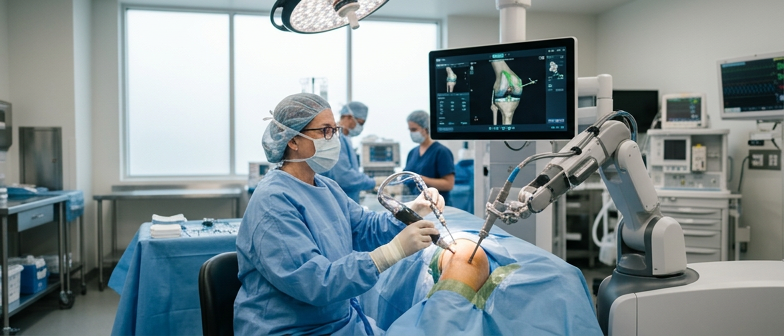
Robotic knee replacement is a knee surgery that uses a computer-guided robotic arm to help the surgeon place the artificial joint with greater precision. Detailed imaging creates a 3D model of your knee to plan how much bone and cartilage to remove and where to position the implant. During surgery, the surgeon stays in control while the robotic system helps keep cuts and implant placement within the plan. This approach can be used for total knee replacement, when all major joint surfaces are replaced, or for partial knee replacement that targets only the damaged part of the joint.
When you look at robotic versus traditional knee replacement, the main difference is how the surgeon plans and executes bone cuts and implant placement. In a conventional procedure, the surgeon relies on standard tools and visual judgment. With robotic assistance, that same skill is supported by real-time data and a system tailored to your individual anatomy. For many people, this personalized alignment and soft-tissue balancing may lead to knee motion that feels more natural, although results still depend on overall health, the severity of arthritis, and the experience of the surgical team. Knowing these basics helps you talk with your orthopedic surgeon about whether a total or partial robotic knee replacement is appropriate for you.
| Option | Key Characteristics | Typical Candidate | Potential Benefits | Main Trade‑offs |
|---|---|---|---|---|
| Traditional Total Knee Replacement | Standard tools, surgeon judgment | Widespread arthritis, typical anatomy | Proven approach, broad availability | Less personalized alignment, variable feel |
| Robotic Total Knee Replacement | Robot‑guided 3D planning | Severe arthritis, complex alignment | More precise implant positioning | Requires specialized team and setup |
| Robotic Partial Knee Replacement | Targets single damaged compartment | Arthritis limited to one area | More natural motion, tissue preservation | Not suited for widespread joint damage |
| Robotic Versus Traditional | Data‑assisted vs manual technique | Patients weighing options | Personalized fit, refined balancing | Similar surgical risks, results vary by surgeon |
Not everyone with knee pain is eligible for robotic knee replacement. Surgeons look at arthritis severity, response to non-surgical treatments, overall health, knee anatomy, and lifestyle goals. Typical candidates have moderate to severe arthritis that has not improved with medications, injections, weight management, or activity changes and are fit for anesthesia. Your doctor reviews weight, bone quality, prior knee surgery, and conditions such as diabetes, heart disease, or smoking. Based on whether arthritis involves one part of the joint or the whole knee, they decide between total or partial robotic knee replacement. Severe deformity, major ligament damage, uncontrolled infection, or an inability to follow recovery instructions may lead to other treatment options. Many people locate robotic knee replacement surgeons near them by asking their primary provider or searching online, then confirm the surgeon’s training in joint replacement and experience with robotic procedures.
Once you and your orthopedic specialist agree to proceed, preoperative planning begins. A CT scan for robotic knee surgery is often used to create a three-dimensional map of your thigh bone, shin bone, and kneecap so the robotic software can plan implant size and position for your individual anatomy. Your surgeon uses this information to simulate the operation, choose between a partial implant and a full replacement, and finalize a personalized surgical plan. At the pre-op visit, the team reviews medications and blood thinners, obtains medical clearances, and explains what to expect before and after surgery, including hospital check-in, pain control, and early movement. If you found a robotic knee surgeon online, this appointment is the time to discuss their results, complication rates, and how using robotic technology might affect your specific risks and recovery timeline.
Before robotic knee replacement, imaging is used to create a highly customized surgical plan. Most patients will have a CT scan specifically tailored for robotic knee surgery, which provides a detailed 3D map of the knee joint, the surrounding bone, and alignment of the leg. The robotic planning software uses this CT data to define exactly how much bone and damaged cartilage should be removed and where the new knee components should be placed for optimal fit and motion. During your preoperative visit, your surgeon reviews these images to confirm that your arthritis pattern, bone quality, and overall alignment make you a good candidate, and to refine the plan so the robot can assist with precise cuts in the operating room.
After robotic knee replacement, the hospital stay is usually brief and centers on pain control, safety, and early movement. Many patients leave the hospital the same day or after one night, depending on age, other medical conditions, and balance when walking. Nurses and the surgical team monitor your vital signs, wound drainage, and knee function while watching for infection warning signs such as fever, spreading redness, or unusual fluid at the incision. Because any knee replacement carries some blood clot risk, you may receive blood thinners, calf compression sleeves, and instructions to move your feet and ankles often to keep circulation moving.
Physical therapy after robotic knee replacement typically begins within hours of surgery, starting in your hospital room. A therapist helps you stand, walk with a walker, and practice getting in and out of bed or a chair. Early sessions focus on gentle range-of-motion, a safe walking pattern, and learning how to protect the surgical knee while staying active. Robotic guidance during surgery can lead to precise implant placement, which may make early motion feel smoother, though soreness and stiffness are still expected. Before discharge, your team reviews pain medicines, incision care, infection red flags, and practical steps to limit blood clot problems, such as taking short walks several times a day.
At home, recovery continues through outpatient therapy and a simple daily exercise routine. During the first six weeks, most people work on improving knee motion, strengthening thigh and hip muscles, and shifting from a walker to a cane, then to walking on their own. Therapists adjust your plan based on overall health and goals, like returning to work or hobbies. To reduce infection risk, you keep the incision clean and dry, follow dressing instructions, and contact your surgeon if you notice new warmth, swelling, or worsening pain. Staying hydrated, taking prescribed blood thinners as directed, and avoiding long periods of sitting without moving your legs further lowers the chance of blood clot complications as your robotic-assisted knee heals.
Physical therapy after robotic knee replacement usually starts the day of surgery and first focuses on gentle knee motion and safe walking. Your therapist shows you how to get in and out of bed, use a walker or crutches, and protect the knee while the incision heals. Early exercises such as ankle pumps, quad sets, and short walks help reduce stiffness, improve bending and straightening, and lower the risk of blood clots while pain and swelling are monitored.
After you leave the hospital, therapy shifts toward rebuilding strength, balance, and confidence with everyday tasks. Home exercises are done several times a day, with outpatient visits to progress the program and fine‑tune technique. Many people manage basic household activities within a few weeks, can often return to driving around four to six weeks if their surgeon agrees, and steadily work toward longer walks and other low‑impact activities over the first three months.
Robotic knee replacement is still major surgery, so it shares many risks with traditional knee replacement, including blood clots, infection, stiffness, and ongoing pain. The risk of clots in the legs or lungs is managed with blood thinners, compression devices, and early walking, and current data show similar clot rates when these steps are used in both robotic and conventional procedures. Infection remains a concern with any implant; careful skin preparation, sterile technique, and antibiotics are used to lower the chance of joint infection, and studies have not shown a clear difference in infection risk specifically related to robotic assistance. Overall complication rates appear comparable when looking at robotic versus traditional knee replacement, with differences seen more in surgical precision, implant alignment, and early function than in safety problems.
Over the long term, robotic technology is designed to improve implant positioning and balance of the soft tissues, which may lead to smoother motion, a more natural feel, and better durability of the knee replacement. Early and mid‑term research suggests high satisfaction and good activity levels after robotic-assisted total knee replacement, but data over several decades are still limited. Results continue to depend on overall health, weight, dedication to physical therapy, and the amount of damage before surgery, so robotic tools do not remove the possibility of persistent discomfort or future revision surgery. When choosing between robotic and traditional approaches, patients still need an experienced surgeon, careful prevention of blood clots and infection, and active participation in recovery and long-term joint care.
How does robotic knee replacement differ from traditional surgery?
Both replace damaged joint surfaces, but robotic systems use a computer-guided arm and real-time data to help the surgeon make more precise bone cuts and implant placement, which may improve alignment and early function.
Why is a CT scan done before robotic knee surgery?
A CT scan creates a 3D model of your knee so planning software can measure how much bone and cartilage to remove and where to place components, allowing the robot to guide the surgeon during the procedure.
Who is usually a candidate for robotic knee replacement?
People with moderate to severe arthritis not relieved by non-surgical care, who are healthy enough for anesthesia and able to follow rehab, may qualify; severe deformity, uncontrolled infection, or major ligament damage can make other options better.
What are the blood clot and infection risks?
The risk of clots and infection is similar to standard knee replacement and is managed with blood thinners, compression devices, antibiotics, sterile technique, and early walking; robotic assistance does not remove these risks or clearly increase them.
What should I expect for hospital stay, cost, and physical therapy?
Many patients leave the hospital the same day or after one night, begin physical therapy right away, and walk with a walker or crutches; insurance coverage and total cost vary by plan and hospital, so confirm details with your surgeon’s office and insurer.