
x
When you’re scaling a drone program, choosing the right Part 107 team training approach determines cost per employee, crew readiness, and waiver success. This guide compares group, self‑paced, and on‑site training, and shows how to standardize hiring, background checks, FAASTeam accounts, and internal documentation.
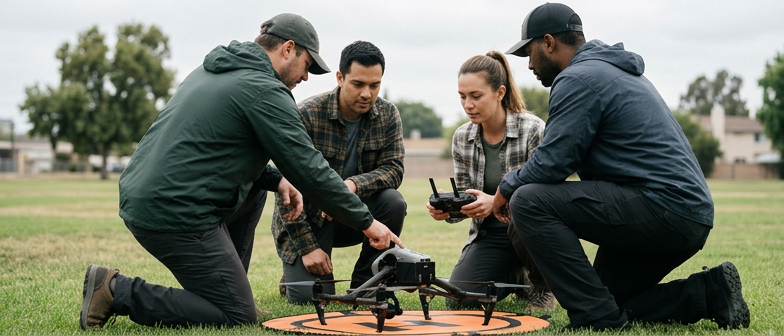
Planning Part 107 training at the team level, instead of treating each pilot as an isolated student, helps you build a consistent, compliant drone program. When you evaluate Part 107 team training options, you can align everyone on standard operating procedures, airspace decisions, and risk assessment, which strengthens safety culture and simplifies internal audits. Corporate drone pilot training classes built for groups also make it easier to standardize how you interpret FAA guidance, document flights, and prepare for advanced operations that may later require waivers or other approvals. A coordinated approach means managers, pilots, visual observers, and data analysts all understand their roles within the same framework.
Looking at the whole group also makes training more scalable and cost effective as your drone program grows. When you work with a drone training company that trains whole crews, you can tailor content to your missions, equipment, and internal policies, something individual prep courses rarely provide. Team‑level planning lets you schedule training around operations, set shared performance expectations, and track who is current, who needs a refresher, and who is ready for more responsibility. Over time, this unified structure shortens onboarding for new hires, streamlines compliance and insurance documentation, and gives leadership a clear view of the program’s readiness for more complex Part 107 missions.
When you evaluate Part 107 team training options, the first step is deciding who is eligible to become a remote pilot in command or supporting crew. The FAA’s ALC-451 module on who is eligible to take it mirrors the Part 107 rules: candidates must be at least 16, able to read, speak, write, and understand English, and be physically and mentally fit to operate a small unmanned aircraft safely. Companies usually select employees with solid performance records, sound judgment in safety-critical roles, and enough schedule flexibility to attend initial training, recurrent training, and regular mission briefings.
Once you know which roles qualify, you can embed the Part 107 certification steps for a new hire into your hiring workflow. Many employers describe the certification path during recruiting, confirm that candidates meet FAA criteria, and make successful completion of training and the knowledge test a condition of employment in a pilot role. A typical sequence is to provide an internal safety orientation, enroll the new employee in a structured Part 107 prep course, schedule the FAA knowledge test, then allow supervised flight operations only after the temporary certificate is issued. Support crew who will not serve as remote pilot in command may not need certification but should still complete internal training on airspace, pilot communications, and company procedures.
Background screening for drone employees usually combines standard HR checks with a focused review of safety and compliance risks. There is no separate federal Part 107 background check for new employees, but because remote pilots are responsible for aircraft, data, and public safety, many organizations review driving records, prior safety incidents, and any regulatory violations, and may add drug or security screening for sensitive missions. Aligning these criteria with your waiver strategy strengthens any future waiver applications, because crew training requirements and safety documentation will rely on proof that pilots were properly vetted, trained, and supervised from the time they were hired.
For a new employee, standardize your internal Part 107 certification steps so every pilot is qualified the same way. Confirm basic eligibility, document that the role includes remote pilot duties, issue written expectations for operating under Part 107, have them review your drone operations manual, and enroll them in the team training option your organization uses, whether a self‑paced prep course or a coordinated group program.
Set a study timeline and assign a training contact to track progress, then have the new hire work through the Part 107 knowledge areas and any internal quizzes you use before scheduling the FAA knowledge test. After they pass, record their temporary certificate, update internal records, and add them to your operations roster only after a supervisor verifies their understanding of company procedures.
When planning Part 107 training for a team, the first decision is usually whether to use structured group training or a self‑paced online course. Self‑study programs fit smaller teams, experienced aviators, or distributed staff who need flexible schedules and the ability to review difficult topics. They are also the easiest way to estimate a basic training cost per employee, since you can add course fees, paid study time, exam charges, and any internal mentoring. Part 107 prep course prices vary widely, so comparing providers on features like lifetime access, practice tests, or guarantees helps you balance cost and value for each new hire.
Group training trades individual flexibility for consistency and speed. A coordinated Part 107 group program keeps everyone on the same timeline and lesson plan, which reduces knowledge gaps and supports standardized procedures after people pass the exam. Corporate drone pilot training classes aimed at teams can embed your policies, airspace approval workflows, and risk processes directly into the curriculum, which is helpful if you expect to scale operations. When weighing group courses against self‑paced learning, consider how quickly you need pilots ready, how comfortable people are with independent study, and whether you have in‑house experts who can reinforce key topics once the course ends.
For larger fleets, complex missions, or teams that need hands‑on practice, an on‑site Part 107 training provider can be the most efficient choice. Local on‑site classes bring instructors to your location for classroom sessions and supervised flights using your own equipment. A drone training company that focuses on whole crews can align content with your operational risks and produce documentation that supports internal audits or future waiver requests. On‑site corporate classes usually cost more up front, but when spread across an entire crew, the per‑employee cost can match or undercut multiple individual licenses, as long as you plan attendance carefully and provide follow‑up resources for later hires.
| Training Option | Best For | Schedule Flexibility | Typical Per‑Employee Cost Trend | Key Advantages / Tradeoffs |
|---|---|---|---|---|
| Self‑paced online Part 107 course | Small or distributed teams | High | More predictable, varies by provider features | Strong individual flexibility, weaker standardization |
| Virtual or in‑person group Part 107 class | Growing teams needing consistency | Medium | Moderate, depends on cohort size and duration | Aligned timelines and procedures, less individual pacing |
| On‑site crew training with provider | Larger fleets and complex missions | Low | Higher upfront, can be efficient when spread across crew | Hands‑on with own equipment, stronger policy integration |
When you budget Part 107 team training options, start by calculating a realistic training cost per employee instead of only looking at the total line item. Add together exam fees, study materials, staff time away from normal duties, and any travel or on site instruction your organization prefers. Then compare typical Part 107 prep course prices across group cohorts and self‑paced offerings so you can see whether a centralized program, a learning stipend, or a mix of both gives you the best value for your training budget and expected hiring pace.
To make Part 107 team training options work at scale, you need internal systems that connect pilot education, currency, and safety reporting in one repeatable process. A key step is creating FAA Safety Team, or FAASTeam, accounts for employees so each pilot can access FAA online courses, WINGS credits, and safety notices under their own profile. When you enroll staff in corporate drone pilot training classes or other group programs, record their FAASTeam username, Part 107 certificate number, and internal employee ID in a central training log that links to your learning management system or HR platform. This lets managers see who has completed initial certification, who is still in Part 107 prep, and who needs recurrent or mission‑specific instruction.
As you compare different Part 107 team training options, decide which data will serve as proof of safety culture, such as completion certificates, FAASTeam course records, internal SOP acknowledgments, and recurrent training dates. Whenever a crew member attends a corporate course or online session, store digital copies of syllabi, attendance, and scores in an organized folder or database filterable by pilot, location, or operation type. These records support internal audits, insurance reviews, client due diligence, and future waiver or authorization requests, and they also make onboarding new pilots into the existing training system faster and more consistent.
Why plan Part 107 training for the whole team instead of sending each pilot to a separate course?
Team‑level training aligns SOPs, checklists, and risk assessments so pilots, visual observers, and managers apply Part 107 rules consistently, which supports audits, waiver applications, and safety culture.
Who in our company is usually eligible to become a Part 107 remote pilot or crew member?
Beyond ALC‑451 basics—age 16+, English, and medical fitness—companies typically choose people with strong safety records, sound judgment, and schedule flexibility for initial and recurrent training.
How do employees create a FAASTeam account as part of our drone training program?
Each person registers on the FAA Safety Team site, then you record their FAASTeam username and, once they pass, their Part 107 certificate number in a central log or LMS.
What are the tradeoffs between group Part 107 training and a self‑paced course for new hires?
Group sessions standardize procedures and allow scenario discussion for crews and waivers. Self‑paced online training is cheaper per employee, easier for remote staff, and scales better with frequent hiring.
How should we estimate Part 107 training cost per employee, including waiver preparation?
Include exam fees, prep course price, paid study time, and any on‑site or corporate classes, plus extra crew training on waiver safety cases and documentation requirements.