
x
Choosing wood grain melamine board for cabinets or millwork often means weighing cost, thickness options, and core materials against high‑pressure laminate. This overview helps you compare performance, emission documentation, and local supply considerations before ordering samples or specifying panels.
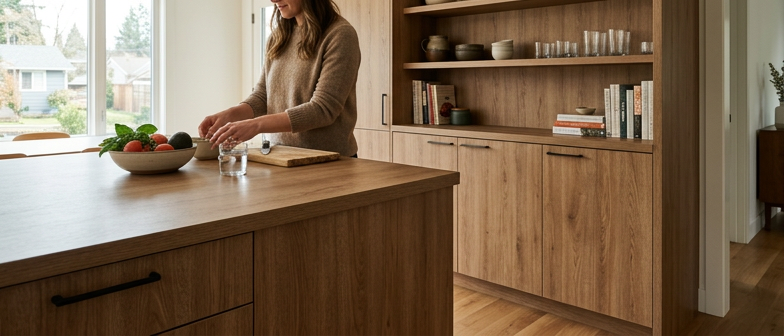
Wood grain melamine board is a decorative composite panel made by bonding a printed, resin‑impregnated paper to an engineered wood core under heat and pressure. The paper carries a wood‑look design such as oak, maple, or walnut, providing a uniform grain appearance without using solid lumber. The core is typically medium‑density fiberboard or particleboard, selected for dimensional stability and a smooth surface. During production, melamine‑formaldehyde resin in the decorative layer cures and fuses with the core, forming a hard, wear‑resistant coating. Manufacturers offer several panel thickness options so fabricators can match stiffness and weight to furniture, cabinetry, and other interior projects.
Because the surface is prefinished, these wood‑pattern panels are widely used in cabinets, shelving, closet systems, office furniture, and other millwork that benefits from a consistent, easy‑to‑clean finish. They make it possible to repeat the same grain pattern across many components, which is harder to achieve with natural veneer. Designers and specifiers often order small woodgrain melamine samples from panel suppliers before starting a project to check color, texture, gloss level, and core type. Comparing sample pieces side by side helps confirm that the selected design and thickness meet visual and performance needs for the intended application.
In millwork, wood grain melamine panels are often compared with high-pressure laminate systems. Melamine is a thermally fused decorative layer applied directly to an engineered wood core, producing a finished board in one press operation. High-pressure laminate is made separately and then bonded to a substrate with adhesives, which can enhance impact and wear resistance and provides broader design flexibility. The separate lamination step, however, adds fabrication time and calls for careful edge treatment to limit chipping or delamination at corners and seams.
When choosing surfaces for casework, shelving, and closet systems, specifiers typically weigh cost, durability, and shop labor. Melamine panels tend to be more economical because the board arrives with an integrated finish that can be cut and edged using relatively simple equipment, making them common for moderate-wear applications such as office furniture and residential storage. High-pressure laminate assemblies usually carry higher total cost due to extra materials and fabrication but are often selected for high-traffic commercial interiors, healthcare, and educational millwork where abrasion resistance, stain resistance, and long-term appearance are critical.
Core selection also influences performance, especially when comparing melamine on MDF to melamine on particleboard. Melamine-faced particleboard is widely used for cabinets and shelving because it is light, cost-effective, and dimensionally stable, though its screw-holding and edge strength are limited compared with denser cores. Melamine over MDF generally offers smoother machined edges, better results with routed profiles, and stronger fastener holding, which supports more intricate millwork or heavier shelving. The trade-off is increased weight and material expense, so cores are typically matched to expected loads, spans, and moisture exposure.
| Option | Relative Durability | Fabrication Complexity | Typical Use Cases | Cost / Core Trade‑offs |
|---|---|---|---|---|
| Wood grain melamine on particleboard | Moderate surface and edge durability | Simple cutting and edging | Cabinet boxes, light‑duty shelving | Lower panel cost, lighter core, limited screw holding |
| Wood grain melamine on MDF | Higher edge integrity and fastener holding | More precise machining, heavier handling | Routed fronts, heavier shelves, detailed millwork | Higher material cost, denser core, better span performance |
| High‑pressure laminate on particleboard | Higher impact and wear resistance | Separate lamination and edge treatment | Moderate‑traffic casework, desks, counters | Added fabrication cost, economical core, basic fastener strength |
| High‑pressure laminate on MDF | High durability with smooth profiling | Most complex fabrication steps | High‑traffic commercial and institutional millwork | Highest overall cost, strong core, supports demanding loads |
In millwork, melamine panels are often chosen for cabinet interiors, closets, and office casework where a consistent wood grain, predictable cost, and fast fabrication are priorities. The woodgrain surface is factory bonded to the core, so parts can be cut, edged, and assembled without an extra laminating step, which usually reduces shop labor and keeps overall panel cost lower for straightforward, flat components.
High-pressure laminate tends to be preferred for transaction counters, reception desks, and other high-traffic fixtures that face frequent impact or require detailed edge work. Although laminate usually raises material and fabrication costs compared with melamine panels, many shops compare laminate versus melamine by weighing expected wear, the likelihood of replacement, and how each option fits their tooling, finishing process, and design flexibility needs.
Woodgrain melamine panels are produced in several thicknesses so designers can balance strength, weight, and cost. Thin boards around 1/4 inch are common for drawer bottoms or cabinet backs, while 1/2 inch and 5/8 inch products are often used for shelves and general casework. Thicker panels near 3/4 inch are selected where stiffness, fastener holding, and long spans are critical. Core type matters at any thickness because denser MDF or particleboard usually gives better screw holding and cleaner machined edges, and the chosen thickness must also suit hardware, edge banding, and handling on site.
A technical data sheet for woodgrain melamine summarizes the physical and mechanical properties of a specific product line so different panels can be compared under consistent test methods. Typical information includes density, internal bond strength, modulus of rupture and elasticity, surface hardness, and screw withdrawal values. Dimensional stability data describe thickness swell and linear expansion after humidity or moisture exposure, while surface performance covers stain, scratch, and light resistance. The document usually identifies core type, decorative surface classification, and formaldehyde emission category, which helps users confirm compliance with standards such as CARB Phase 2.
Translating these values into project choices requires linking numbers to service conditions. High screw holding and bending strength are most important for long shelves, wall hung cabinets, and hardware that carries significant loads. Dimensional stability figures guide panel selection in spaces with variable humidity, where low thickness swell helps reduce visible movement at joints and edges. Surface performance data indicate whether a given woodgrain finish is suited to high traffic vertical applications or better reserved for light duty use, allowing designers to match thickness, core, and surface to expected durability and documentation needs.
A Woodgrain melamine technical data sheet links panel properties to common uses and helps you move beyond visual impression. Focus first on thickness and recommended applications so cabinet boxes, shelving, or decorative millwork have appropriate load capacity. Then review the core, such as MDF or particle board, and note density, screw-holding, and machining behavior to anticipate hardware performance and edge quality. Finally, check surface data like abrasion, stain and scratch resistance, and response to heat or moisture. After narrowing options, ordering samples that correspond to the data sheet lets you confirm color, texture, and sheen under project lighting and align technical specifications with your design intent.
For wood grain melamine boards used in cabinets, furniture, and other millwork, formaldehyde emission limits are a key safety and specification concern. The composite wood cores, such as particleboard, MDF, or hardwood plywood beneath the decorative surface, must comply with programs like CARB Phase 2 and the federal TSCA Title VI rule. Requests for CARB Phase 2 documentation typically focus on evidence that the core panel has been tested and certified, not the printed paper overlay. Panel producers usually work with accredited laboratories, third‑party certifiers, and ongoing quality control testing to show that emission levels remain within required limits over time.
In practice, buyers and specifiers are often advised to obtain compliance statements, test reports, or independent certificates that reference the relevant CARB or TSCA Title VI standards, panel type, and production dates. TSCA Title VI documents for woodgrain melamine may appear as mill certificates, unit labels, or downloadable technical sheets summarizing emission class, test methods, and manufacturing sites. Keeping this documentation organized supports due diligence when projects must demonstrate that all composite wood components meet regulations. When reviewing potential suppliers, it is useful to confirm that their technical data sheets and emission declarations are current, traceable to recognized certification bodies, and match the thicknesses, substrates, and finishes being ordered.
What is a wood grain melamine board?
It is an MDF or particleboard panel pressed with melamine‑saturated decorative paper that imitates wood such as oak or maple, creating a hard, prefinished surface for interior millwork.
How does melamine compare with high pressure laminate in millwork?
Melamine is fused to the core in one press and suits flat, standard parts. High pressure laminate is made separately and glued on, offering higher impact resistance and more design choices but requiring extra fabrication and edge treatment.
What thicknesses are typical for woodgrain melamine panels?
About 1/4 inch is common for backs and drawer bottoms, 1/2 to 5/8 inch for shelves and cases, and around 3/4 inch where more stiffness, span capacity, and screw holding are needed.
How should I use a technical data sheet before ordering woodgrain melamine samples?
Review recommended thickness, core density, and screw‑holding values, then check abrasion and stain resistance, and only after that request color and texture samples that fit the documented properties.
What needs checking in CARB Phase 2 and TSCA Title VI documents for these panels?
Confirm the composite wood core itself is listed as compliant, testing was done by an approved third‑party, and coverage is current for the specific panel type and manufacturer.