
x
Engineers and planners weighing plastic extrusion technology need clarity on process capability, cost, and material choices. This overview compares core extrusion steps, optimization for film and profiles, CAD needs for custom tooling, sustainability considerations, and typical factors in selecting equipment or estimating production costs.
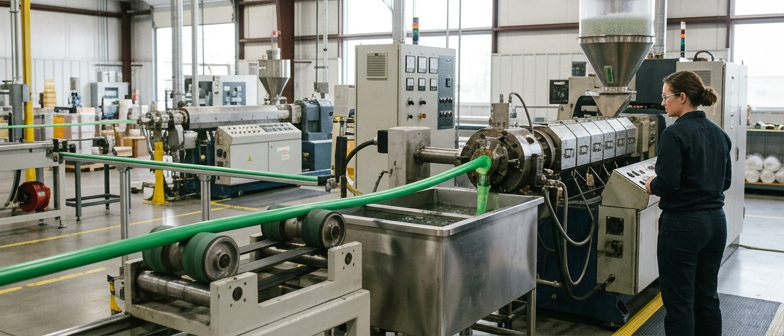
Plastic extrusion technology is a continuous process that transforms raw polymer materials into long, uniform products such as films, pipes, profiles, and sheets. Thermoplastic pellets or granules are introduced into a heated barrel, melted, and transported by a rotating screw toward a die that sets the final cross section. Because the process can run at steady state for long periods and provides good dimensional control, it is widely used in industrial plastics manufacturing and links efficiently to downstream cooling, cutting, and surface conditioning operations. Compared with other core plastics processes such as injection molding, blow molding, and thermoforming, extrusion is characterized by producing continuous rather than discrete parts.
A typical manufacturing overview of extrusion equipment includes the material feed system, one or more screws and barrels, heaters and cooling zones, the die assembly, and systems for monitoring and control. Single screw machines are common for basic melt processing, whereas twin screw extruders are used when enhanced mixing, compounding, and tighter control of material properties are required. Industrial lines may also incorporate melt pumps, screen changers, and instruments measuring pressure, temperature, and throughput to maintain stability and traceability. Technical literature on plastic extrusion examines how polymer structure, rheology, screw design, die geometry, and thermal profiles interact, providing a basis for modern process optimization and scale up in industrial applications.
In plastic extrusion, dry resin and additives are fed into a hopper and moved along a heated barrel by a rotating screw. Temperature profiles and screw geometry control melting and mixing, turning pellets into a uniform molten polymer. The pressurized melt is pushed through a die that defines the product cross section, such as film, sheet, pipe, or custom profiles. Cooling, sizing, and haul off equipment then stabilize dimensions and surface finish and help limit residual stresses that could cause warpage or instability during use.
Optimization focuses on controlling variables like melt temperature, screw speed, back pressure, and line speed, along with monitoring die pressure and product dimensions. Advanced approaches use closed loop control of barrel zones based on real time temperature feedback and automated thickness or profile measurement to keep tolerances within target ranges. Screw and die designs are selected for each polymer and geometry to limit shear damage, improve mixing of colorants and modifiers, and shorten transition times between product runs, supported by clear startup and shutdown procedures.
Process optimization also influences energy use and cost per unit, which is important when estimating extrusion production costs or comparing equipment and formulations. Lower scrap rates through better dimensional control, faster changeovers, and resin grades that run efficiently at reduced temperatures can all improve economics. Collecting data on throughput, downtime, and maintenance helps separate fixed costs, such as equipment and facility, from variable inputs like material, labor, and utilities, and links quality results to specific process settings and spending.
| Process Variable | Impact on Quality | Impact on Throughput | Impact on Unit Cost |
|---|---|---|---|
| Melt temperature profile | Dimensional stability high when controlled | Throughput moderate; excess heat risks defects | Energy use and scrap lower with optimized settings |
| Screw speed | Surface finish sensitive at very high speed | Throughput high but limited by mixing and cooling | Cost per unit lower if scrap and downtime stay low |
| Back pressure | Mixing and color dispersion improved at balanced level | Throughput reduced if pressure excessive | Unit cost optimized when balance avoids rework |
| Die pressure and design | Profile accuracy high with stable pressure | Throughput moderate; flow restrictions can limit output | Tooling and maintenance costs offset by lower scrap |
| Line speed and cooling intensity | Dimensional control sensitive to cooling uniformity | Throughput high when cooling matches speed | Lower cost per unit if quality maintained at higher speed |
In industrial plastic extrusion, unit cost and throughput depend on machine size, screw design, and whether new or used extruders are selected. High-output lines can lower cost per pound when demand and uptime are stable but increase capital and maintenance needs. When considering a used extruder, planners look at expected reliability, fit with existing tooling, and efficiency compared with current designs because these factors shape long-term cost and delivery performance.
Material selection for plastic extrusion starts with the end-use environment, regulatory expectations, and required mechanical and thermal properties. Common materials such as polyethylene and polypropylene are used for film, sheet, and profiles, while more specialized polymers are chosen when higher chemical resistance, clarity, or heat performance is needed. Additives like processing aids, stabilizers, slip agents, and pigments are added to adjust melt flow, improve surface quality, and extend service life, but they also change viscosity, die swell, and cooling behavior. Effective formulation work balances processability with product performance and ensures compatibility with the chosen extrusion line.
Stable production depends on matching materials to appropriate equipment. Film products often run on polypropylene film extrusion lines with screw designs suited to the resin melt characteristics, temperature zones that protect the polymer, and cooling systems that control thickness and appearance. Sheet and profile lines use screws, barrels, and dies selected for melt index and thermal sensitivity, supported by downstream calibration and haul-off units that keep dimensional tolerances. Where coextrusion, melt filtration, or automatic thickness control are needed, extruder size, drive power, and control systems are specified to handle the rheology of the material and the complexity of the product structure.
Plants compare new and previously owned extrusion equipment to manage capital and lifecycle costs. A used extruder can be suitable for standard materials and simpler geometries when screw and barrel wear are within acceptable limits and the drive still delivers stable output. Many processors upgrade heaters, instrumentation, and safety systems so older equipment can handle current formulations and quality requirements. Before purchase, they review expected throughput, energy use, maintenance records, and compatibility with existing dies and downstream units, then align material families, additive packages, and planned production rates with the realistic capabilities of each line.
For custom plastic extruded profiles, CAD data must define the cross‑section geometry, datums, and how the profile interfaces with mating parts so processors can design suitable extrusion tooling. Drawings specify dimensions with realistic tolerance bands and highlight critical features such as sealing surfaces or snap‑fit details. Designers also document nominal wall thickness, allowable variation, and smooth radius transitions to support melt flow and reduce stress. Early collaboration between the design team and the extrusion processor links functional requirements to die design, cooling, and puller constraints, often using CAD models or basic simulations to refine thicknesses, add support ribs, or adjust tolerances before tooling is manufactured.
Sustainability in plastic extrusion focuses on reducing energy use, improving material efficiency, and limiting environmental impact while preserving industrial performance. Resin families such as polyethylene and specialized polymer compounds are chosen for mechanical properties as well as recyclability and compatibility with reprocessed feedstocks. Closed-loop concepts encourage reuse of scrap, and process optimization through accurate temperature control, efficient screw design, and consistent die maintenance helps cut waste and electricity demand. Many facilities also consider life-cycle aspects, linking decisions on raw material sourcing and end-of-life options for extruded products with broader environmental objectives rather than only short-term output.
Region-specific solutions reflect local regulations, infrastructure, and customer expectations, which is evident in states with strong environmental and safety rules such as Washington. Operators of industrial plastic extrusion equipment must interpret requirements on emissions, worker protection, and waste handling when selecting lines, filtration, and automation. Access to nearby technical support, laboratories, and material suppliers shapes practical choices of resins, additives, and operating windows. By integrating sustainability measures with local regulatory frameworks and available utilities, extrusion operations can design processes that comply with legal standards, align with community priorities, and remain economically realistic over time.
What distinguishes industrial plastic extrusion technology from processes like injection molding?
Extrusion produces continuous products such as film, pipe, and profiles by pushing molten polymer through a die, while injection molding fills a closed mold to make discrete, individual parts.
How can the plastic extrusion process be optimized for throughput and quality?
Optimization focuses on screw design, stable temperature profiles, controlled melt pressure, and well‑designed cooling and haul‑off systems to reduce scrap while maintaining dimensional accuracy.
What should designers include in CAD files for custom extruded profiles?
CAD data should clearly define the cross‑section, key datums, tolerances, wall thickness, radii, and critical functional surfaces, and be shared early so tooling and cooling strategies can be aligned with the design.
What factors affect the choice between a new and a used plastic extruder for sale?
Decision makers compare expected reliability, available screw and die options, energy efficiency, maintenance history, and how well the machine integrates with existing downstream equipment and product mix.
How do sustainable plastic extrusion methods reduce environmental impact?
They use recyclable materials and regrind, optimize energy use through efficient heating and screw designs, and minimize waste via better process control and closed‑loop handling of production scrap.