
x
If you are comparing industrial mixer options for liquids, powders, or dough, it can be hard to match equipment to process needs and budgets. This guide helps you weigh batch versus continuous designs, new versus used units, and what data you need for sizing, quotes, and maintenance decisions.
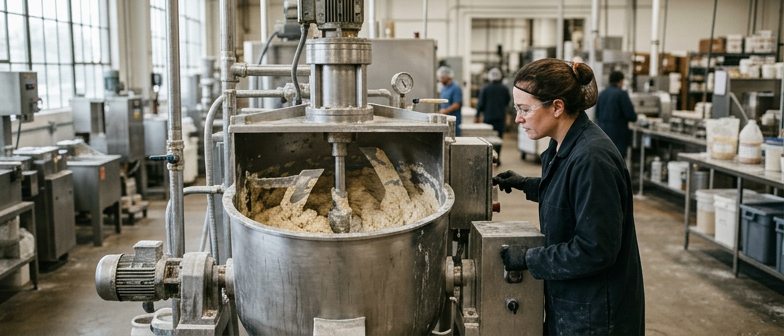
Industrial mixers blend, disperse, emulsify, or keep materials in suspension so a process delivers consistent quality. They are used for liquid chemicals, slurries, dry powders, and doughs, and their design affects energy use, product uniformity, and ease of cleaning and maintenance. A basic distinction is between equipment handling liquids and slurries, such as tank agitators with impellers, and machines for powders, pellets, or pastes, such as ribbon blenders and planetary dough mixers. Within each group, geometry, horsepower, and shaft speed are matched to properties like viscosity, particle size, and the level of shear the formulation can tolerate without damaging sensitive ingredients.
Another important grouping is batch versus continuous operation. Batch mixers work on a defined volume in a tank, drum, or bowl and are common where recipes change often, traceability matters, or cleaning between campaigns is required. Continuous systems feed and discharge at the same time and are chosen for steady, high-throughput production with a uniform feed stream. This framework also shapes purchasing decisions. Buyers weigh new versus used equipment in terms of service life, retrofit effort, and downtime risk, and may prefer suppliers with mixers available from stock when project schedules are tight.
Batch mixers for IBC totes, drums, and small tanks are usually chosen around three basics: mounting style, available power, and how difficult the material is to blend. Tote mixers often use bridge, lid, or cap mounts so they can be installed without altering the container, which matters when totes are moved by forklift or pallet jack. Drum mixers are commonly bung or clamp mounted on 55‑gallon drums, but the narrow opening can restrict impeller size and mixing intensity. Some materials, such as viscous doughs or products that are very sensitive to aeration, are better served by dedicated batch machines, and industrial dough mixers are a typical case where bowl shape and agitator style are closely matched to product rheology.
Before asking suppliers about tote agitators, drum‑mounted units, or other batch systems, it is useful to define a few sizing and configuration points so pricing and lead times can be compared fairly. Key details include batch volume, viscosity range, solids content, target mixing time, preferred power source such as electric or air, and any limits on weight, noise, or ease of cleaning. Comparing a drum mixer with a tote mixer also involves considering how often containers are swapped, what operators can safely lift or reposition, and how completely material must be blended before discharge. When these basics are shared with distributors that keep equipment in stock, they can evaluate whether a standard mixer is likely to meet the requirement or whether a customized design and more detailed sizing review are appropriate.
| Batch Mixer Type | Typical Use Case | Mobility & Container Swapping | Cleaning Effort | Mixing Intensity Suitability |
|---|---|---|---|---|
| Drum mixer | Standard liquids in 55-gallon drums | High for single drums, limited by handling | Moderate, small openings slow access | Low to medium, restricted impeller size |
| IBC tote mixer | Larger liquid batches in IBC totes | High when totes are moved by forklift | Moderate, depends on tote interior | Medium, good for general blending |
| Dedicated batch tank mixer | Repeat batches with tighter control | Low, tank is usually fixed in place | Varies, can be designed for cleanability | Medium to high, more flexible geometry |
| Industrial dough mixer | Viscous doughs or shear‑sensitive pastes | Low, product loaded into fixed bowl | Higher, more contact surfaces | High for viscous mixing, low aeration |
A batch mixer sizing worksheet converts process conditions into design choices, so it typically collects vessel geometry, operating volume, fluid properties, and the planned duty. Common entries include tank diameter and liquid height, working and maximum fill levels, density and viscosity at operating temperature, and whether the contents are clean liquids, slurries, powders being wetted, or shear sensitive products. The form often asks for the main objective, such as blending, solids suspension, or gas dispersion, along with required mixing time, available power supply, and limits on speed, noise, or mechanical load. For chemical service, information on corrosive components, vapors, and safety margins is used to select materials of construction and sealing arrangements as well as motor power.
Once the application data is defined, mixer specialists use correlations and prior experience to select impeller type, diameter, shaft length, speed, and estimated power, then adapt the layout to a fixed tank, drum, or intermediate bulk container. The same data supports quotations for portable agitators installed through tote openings, where access size, baffle details, and the need for quick setup influence the proposal. Reliable inputs help avoid drives that are too small to meet mixing targets or oversized units that waste energy or cause excessive shear. When requesting a quote, including realistic process ranges and any future scale up plans gives suppliers clearer boundaries and supports batch mixer selections that are easier to defend in internal reviews.
Continuous mixers feed materials while discharging product, creating a steady process instead of discrete batches. They are used where high throughput, consistent quality, and controlled residence time matter, such as powder blending, chemical processing, and some food or pharmaceutical lines. Compared with batch systems, they can reduce handling and improve repeatability, but they depend on accurate upstream metering, appropriate instrumentation, and careful integration with conveying, dosing, and downstream packaging or reaction stages.
When selecting continuous mixing equipment from local sources, engineers often start with nearby distributors and confirm which models are available from stock, since lead time and spare parts access can affect project schedules. New machines usually provide current safety features and manufacturer support, while used mixers may lower initial cost but call for thorough inspection, possible refurbishment, and verification of documentation. Assessing the dealer’s technical support, commissioning services, and long term maintenance options helps align the chosen mixer with process needs and life cycle expectations.
Choosing between new and used industrial mixers involves balancing reliability, documentation, and risk over the mixer’s service life. New units usually include complete drawings, modern safety features, clear manuals, and a warranty, which can simplify compliance reviews and spare‑parts planning but increase the initial purchase cost. Preowned mixers often reduce upfront spending, yet records on past loading, corrosion, or repairs may be incomplete, raising uncertainty about seals, gearboxes, or fatigue and affecting long‑term cost.
Lead time and flexibility also differ. Standard models held in stock by industrial mixer suppliers can be delivered relatively quickly, while custom designs that match specific tank dimensions, viscosities, or hygienic requirements add engineering time and extend delivery. A used mixer may be installed sooner if it already fits existing mounts and utilities, but modification limits and updated codes can restrict changes. Comparing the time needed for any adaptation with the expected remaining service life helps clarify total lifecycle cost.
Industrial mixers use different drive and sealing combinations to transmit power into a tank while containing product. Common drives include direct-drive motors, gear reducers that provide lower speed and higher torque, and belt drives that allow some speed adjustment. Where purity or leak containment is critical, designers may consider magnetic drive mixers and evaluate how well they isolate the process from the motor and bearings. Operating pressure, temperature, and cleanability guide the choice between a conventional shaft seal and a sealless magnetic arrangement.
Seal selection strongly affects long-term reliability and leak control. Basic lip seals and packed stuffing boxes can suit nonhazardous, low-pressure duty, but they often need frequent adjustment and replacement. Mechanical seals, including double or cartridge designs, are more complex yet can improve containment for chemical or hygienic products when sized and installed correctly. When leakage, product buildup, or shaft damage appears, a structured seal repair plan that includes root-cause analysis, material review, and checks of shaft alignment helps reduce repeat failures instead of relying only on scheduled part changes.
Gearboxes and other drive components shape maintenance strategies because they influence vibration, load distribution, and service intervals. High-torque, low-speed mixers commonly use gear reducers, so operators monitor oil condition, temperature, and noise to decide when repair or replacement is justified. Requesting a detailed quotation for a replacement gearbox helps compare options such as higher service factors, added condition monitoring, or a different drive style. Coordinating seal upgrades, drive selection, and preventive maintenance can extend mixer life and reduce unplanned downtime while protecting safety and product quality.
How are industrial mixers grouped for liquids versus powders?
Liquids and slurries are usually mixed with tank agitators using impellers selected for viscosity, flow pattern, and allowable shear. Powders, pellets, and doughs rely on devices like ribbon blenders or planetary dough mixers, chosen by bulk density, flowability, and required mixing intensity.
What information is needed for an IBC tote agitator quote?
List tote volume and dimensions, fluid viscosity and density, mixing goal such as blending or solids suspension, available power supply, mounting style like bridge or lid mount, and any needs for cleaning access, portability, or vapor containment.
How does a batch mixer sizing worksheet support chemical tank design?
It records tank size and liquid level, fluid properties at operating temperature, mixing objectives, and limits on power and speed so impeller type and motor size can be set. For chemicals it also notes corrosive components, vapors, and safety margins to guide materials and seal selection.
When do continuous mixers benefit from local dealers?
Nearby suppliers can help when onsite support, quick spare parts, or coordination with local fabricators is important. For complex continuous lines, proximity may simplify commissioning and troubleshooting if the dealer also documents process performance and safety compliance.
Why do custom industrial mixers have longer lead times than stock units?
Custom units require engineering of impellers, drives, materials, and seals to specific process data, then fabrication and testing. Standardized in‑stock mixers offer fewer options but can usually be delivered sooner when they still fit the required duty.