
x
If you’re overwhelmed by choosing a homeschool curriculum, this guide walks you through beginner‑friendly options—from complete and secular plans to free online programs and budget books—so you can build a realistic elementary homeschool year that fits your child and your schedule.
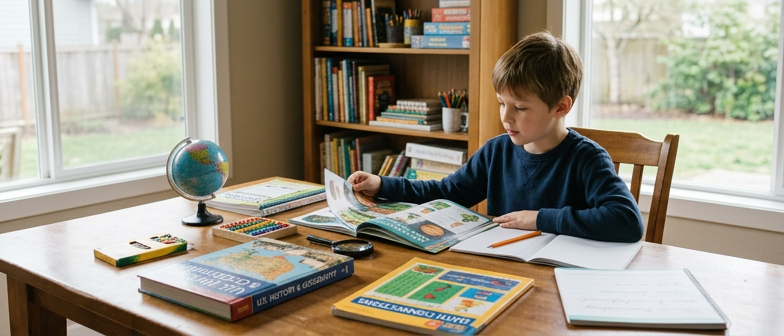
When you are brand‑new to homeschooling, it helps to start with a simple definition. A homeschool curriculum is the overall plan for what your child will learn, which resources you will use, and how you will structure lessons at home. For families exploring homeschool curriculum for beginners, it is tempting to hunt for the single best homeschool curriculum that promises to work for every child. In reality, even a complete homeschool curriculum is just a tool kit. Your child’s age, learning style, and interests, along with your teaching comfort level and schedule, all shape how well any program works in daily life.
Before choosing materials, check your state’s homeschool laws so you understand required subjects, record‑keeping, and testing, then decide how formal or relaxed you want your days to feel. Some families like a boxed program that outlines a full year in one package, while others combine different subjects and build their own mix from various publishers, local classes, and online options. Instead of chasing what someone else calls the best homeschool curriculum, ask whether a program fits your goals, values, and budget. Give yourself permission to start simple, notice how your child responds, and adjust as you go rather than expecting your first plan to be perfect forever.
When parents start searching for the best homeschool curriculum, they usually bump into a few major categories. A complete homeschool curriculum, sometimes called a boxed or all‑in‑one program, provides coordinated materials for multiple subjects and often includes pacing guides and assessments, which can be reassuring for new families. Online homeschool programs deliver lessons through videos, interactive exercises, and auto‑graded quizzes, reducing the amount of daily planning a parent has to do. In contrast, literature‑based and unit‑study approaches build learning around rich books and themes, giving more room for customization and family discussion while still covering core skills.
Another key distinction is between faith‑based and secular homeschool curriculum. Secular options are written without religious doctrine and focus on academic standards, which can make it easier to mix and match resources or align with public‑school expectations. Families might choose a secular math or science program and pair it with an online platform for enrichment, or use a full, pre‑planned package as their spine and supplement with library books and hands‑on projects. Understanding how these main types differ in structure, worldview, and level of parent involvement helps you narrow the field before you commit money or time to any specific program.
| Curriculum Type | Structure & Worldview | Parent Involvement | Flexibility | Typical Cost Level |
|---|---|---|---|---|
| Complete or boxed program | Highly structured, often faith-based or mixed | Moderate, focused on guiding and checking work | Lower, follows preset pacing | Medium to higher |
| Online homeschool program | Structured digital courses, varied worldview | Lower for daily teaching, higher for oversight | Medium, depends on platform settings | Low to medium |
| Literature-based or unit study | Book-centered, can be secular or faith-based | High, planning and discussion heavy | High, easy to adapt topics and pace | Low to medium |
| Secular curriculum mix-and-match | Aligned to academic standards, non-religious | Medium, choosing and coordinating pieces | High, easy to swap resources | Wide range, from free to moderate |
When comparing any online homeschool program, look at how it fits your daily routine and your goals for independence. Some platforms feel like virtual school with video lessons, auto-graded quizzes, and pacing guides, while others simply give you plans you can rearrange. Families searching for the best homeschool curriculum often want clear progress tracking, built-in review, and the freedom to slow down or move ahead. Use free trials to test whether the teaching style keeps your child engaged on a screen and whether the workload is realistic.
If you want a secular homeschool curriculum, focus on how each program approaches history, science, and literature, where worldview shows up most clearly. Neutral options lean on evidence-based content, encourage critical thinking, and separate personal belief from academic explanation. Compare sample lessons from several providers and notice tone, assumptions, and discussion prompts so you still get a complete, coherent course of study rather than disjointed activities.
Building a strong homeschool curriculum does not have to be expensive. Many families combine a free homeschool curriculum with low-cost print materials to cover core subjects. High-quality online homeschool programs can provide full courses in math, reading, science, and history at no charge, with video lessons, practice, and basic progress tracking. Public libraries add another layer of savings with classic literature, science biographies, and reference books that can be turned into reading lists or research projects. By matching these resources to your learning goals instead of grabbing every free offer, you keep the plan coherent and avoid overwhelming your child.
When you do purchase materials, choose a few affordable homeschool books that provide scope-and-sequence plans, answer keys, and hands-on activity ideas you can reuse across grades. Many secular and faith-neutral providers offer inexpensive digital editions or used copies, which stretch your budget while still feeling organized. You can pair a free online course for direct instruction with a low-cost workbook or spine text to provide written practice and a record of learning. Over time, this blend of no-cost online resources, carefully chosen budget-friendly books, and steady library use can function like a complete homeschool curriculum without putting financial strain on your family.
When you are just starting and want a homeschool curriculum for beginners, keep your plan small and clear. Pick one or two affordable homeschool books for math and reading that you can see yourself using every day, then add a single free homeschool curriculum website for videos and practice. This simple mix gives you a solid starting point while you discover your daily rhythm, instead of piling up resources you never open.
When you plan an elementary homeschool year, start with a simple structure instead of searching endlessly for the one best homeschool curriculum. List the core subjects you must cover and check any state rules, then decide whether you prefer a complete homeschool curriculum that bundles everything or a mix-and-match plan. Younger children usually do best with short lessons, hands-on work, and plenty of read-aloud time, so keep the schedule light enough that you can follow it most weeks.
Next, sketch a daily and weekly rhythm that fits your family. Many parents put reading, writing, and math in the morning, then rotate science, history, and arts in the afternoon. An elementary homeschool plan does not need to fill every hour; leave space for independent play, outdoor time, and practical life skills. If you use a more all-in-one program, feel free to cut busywork so your child does not burn out and you still have energy for real-world learning.
As you gain confidence, adjust the plan to your child’s interests and pace. A curriculum designed for beginners can give you scripts, schedules, and checklists, while leaving room to follow curiosity about animals, space, or building projects. Review your plan every month, drop what is not working, and swap in resources that better match your idea of the best homeschool curriculum for your child so the plan becomes a living document you refine over time.
What exactly is a homeschool curriculum when you are just starting out?
It is your overall plan for what your child will learn, which books and online tools you will use, and how you will structure daily lessons at home.
How can I choose the best homeschool curriculum for my child?
Start from your child’s age, learning style, and interests, plus your schedule. Look for a program whose pace, teaching method, and workload match your real life, not just its promise to be “the best.”
What should a beginner include in a simple, complete homeschool curriculum?
Cover reading, writing, math, basic science, and history with materials you can realistically use most days, keeping lessons short and clear while you learn your family’s rhythm.
Are there truly free homeschool curriculum options that work?
Yes. You can combine free online courses and practice sites with library books. The key is picking a few aligned resources instead of collecting every free download you see.
How do I plan an elementary homeschool year on a budget?
List required subjects, choose one or two affordable core books, add a secular online program or videos for practice, and keep the schedule light with plenty of read‑aloud time.