
x
Struggling to align injection molding equipment with FDA expectations? This guide clarifies how to build IQ/OQ/PQ for molding cells, manage cleanroom and maintenance requirements, and budget for validation and documentation across Class II and Class III medical device programs.
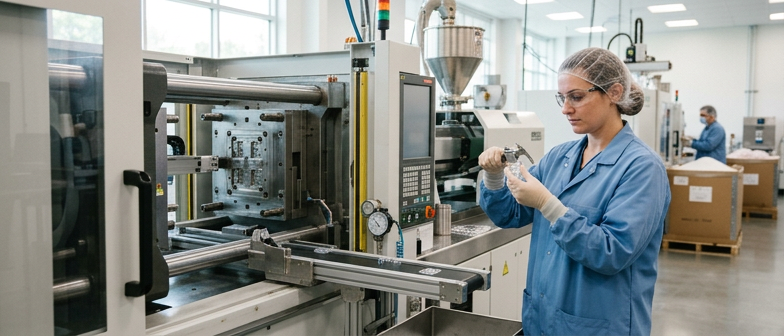
FDA requirements for molding equipment come from medical device quality system regulations, which treat injection molding presses and auxiliaries as process equipment that can directly affect product quality. For higher risk products, especially those meeting Class III medical device molding requirements, the molding process is handled as a special process because defects may not be visible by normal finished product inspection. As a result, the equipment, utilities, software, and control systems must run within defined and justified ranges for temperature, pressure, speed, and cooling so molded parts consistently meet design specifications and critical quality attributes.
Within this regulatory context, FDA and ISO 13485 require a structured validation and documentation strategy for molding equipment. A typical molding equipment documentation package covers user requirements, functional specifications, qualification and validation protocols and reports, calibration and maintenance records, alarm and interlock checks, and clear links to device risk analysis and drawings. For complex or implantable devices that fall under stringent Class III medical device molding requirements, regulators scrutinize this documentation to confirm that process capability, equipment controls, and change management are rigorously defined, and that the molding machinery is a validated, traceable part of the overall manufacturing system.
Designing a qualification strategy for molding equipment starts with interpreting FDA requirements for molding equipment in the context of device classification, intended use, and risk. Under process validation expectations, the manufacturer must show that molding machines, auxiliaries, and controls consistently produce components meeting specifications. This requires mapping each molding step to regulatory expectations, defining which machines and tooling are in scope, and deciding when full process validation is needed versus documented verification. At the same time you outline how molding parameters, material controls, and inspection methods will fit into the overall equipment and process strategy so that the qualification effort is proportional to product risk and business needs.
Once the scope is clear, you build a structured plan for IQ, OQ, and PQ for molding equipment that fits within the quality system. IQ confirms installation, utilities, safety features, and software configuration and forms the base of the molding equipment documentation package. OQ challenges operating ranges for key settings such as injection pressure, screw speed, and cooling times to define proven acceptable windows. PQ runs at nominal conditions with production tooling, materials, and operators to demonstrate repeatability and capability. Protocols should link process inputs to product requirements, define sampling and statistics, and specify documentation outputs, including molding equipment calibration records and updated work instructions.
Cost control is built into the strategy by planning documentation and test depth up front instead of adding studies reactively. The cost of molding equipment qualification is driven by the number of machines and molds, control complexity, test part volume, and subject matter expert time for protocol authoring and execution. To manage this, organizations standardize IQ OQ PQ templates across molding cells, reuse common test plans where justified, and stage qualification activities alongside normal engineering builds. A well-designed strategy also defines how requalification will be triggered, reducing long-term validation expense while still satisfying FDA expectations for reliable, compliant molding processes.
| Qualification Approach | Typical Device Risk Class | Cost / Effort Level | Documentation Depth | When It Is Most Appropriate |
|---|---|---|---|---|
| Basic documented verification only | Low to moderate | Low | Lean records, focused checks | Simple molds, well‑understood processes |
| Streamlined IQ/OQ with limited PQ | Typical Class II | Medium | Standardized IQ OQ PQ package | Moderate risk parts with stable designs |
| Full IQ/OQ/PQ with expanded studies | Higher‑risk Class II | Medium to high | Detailed protocols, rich data sets | Critical dimensions or tight tolerances |
| Enhanced IQ/OQ/PQ plus requalification plan | Class III or implantable | High | Comprehensive validation file | Special processes where defects are hard to detect |
An effective IQ, OQ, and PQ protocol for molding equipment starts by defining the intended medical molding process and linking every test to process validation requirements. Installation Qualification documents that the press, auxiliaries, and mold are installed and configured as specified, with utilities, safety interlocks, software versions, and molding equipment calibration records verified. Operational Qualification then challenges the molding cell across a justified window of settings to validate molding temperature and pressure, shot size, cooling time, and clamp force, using calibrated instruments and structured test plans tied to critical quality attributes.
Performance Qualification confirms that the nominal parameters selected during OQ can repeatedly produce conforming parts under routine conditions. A robust PQ for injection molding sets clear acceptance criteria such as capability indices for key dimensions, cavity balance, scrap limits, and evidence that temperature and pressure stay within the validated bands over multiple lots. The IQ/OQ/PQ protocol must also define sampling plans, statistical methods, and documentation so the overall validation package shows a stable, capable molding process.
FDA expectations for molding validation scale with device risk. For moderate‑risk products such as many Class II devices, you still need full process validation, but the depth of studies, number of lots, and tightness of acceptance criteria can be tailored through documented risk analysis that links molding conditions to patient impact. For high‑risk products, especially those falling under Class III medical device molding requirements, regulators expect a more conservative approach, with expanded testing, more lots and cavities sampled, and clear justification whenever you narrow the validation scope.
The contrast between Class II and Class III molding validation is most visible in how you define and defend the molding process window. For higher‑risk implants or life‑supporting devices, you must show that temperature, pressure, and cooling time variation keeps parts within clinically safe performance limits, often with more worst‑case studies and additional dimensional and degradation analyses. For lower‑risk products, you may rely on fewer challenge conditions if you can demonstrate that even substantial variation in molded dimensions or surface condition does not increase clinical risk.
Cleanroom requirements for medical molding add another layer to validation. When molding occurs in an ISO‑classified environment, you must demonstrate that particulate levels, bioburden, and environmental excursions do not compromise the validated state, often by integrating environmental monitoring with process capability studies. For high‑risk and sterile Class III devices, regulators expect the interaction between cleanroom controls, material handling, and molding parameters to be clearly described, and for the validation package to show that the process remains capable under routine and worst‑case environmental conditions.
For medical molding, cleanroom requirements are driven by device risk and the impact of particulates and bioburden on patient safety. Components for sterile barriers or implants are typically molded in ISO-classified cleanrooms with controlled air changes, filtration, and pressure differentials, and these controls must be justified in the process validation file. For Class III medical device molding requirements, manufacturers must show that cleanroom design, gowning, material flow, and segregation of nonconforming product prevent contamination that could compromise safety or effectiveness. Environmental controls around molding equipment must be part of IQ, OQ, and PQ so temperature, humidity, airborne particles, and microbial levels are monitored and kept within defined limits. Procedures should define how doors, conveyors, auxiliary equipment, maintenance, and mold changes interact with the controlled environment, how excursions are investigated, and how evidence shows cleanroom classification, routine monitoring, and responses remain effective over time.
Once process validation is complete, molding equipment must be run in a tightly controlled state so the validated window remains intact over time. Manufacturers should monitor and periodically re-verify critical process parameters, especially melt and mold temperature and cavity pressure, to ensure they stay within the proven ranges established during validation runs. Using in-line sensors, alarms, and routine data reviews to confirm molding temperature and pressure supports regulatory expectations for process control and provides early warning when the process begins to drift toward the validated limits.
Long-term control depends on a structured, risk-based preventive maintenance program for molding equipment that is fully documented. Lubrication, replacement of wear components, cleaning of vents and cooling channels, and checks on heaters, thermocouples, and pressure transducers should have defined frequencies tied to historical performance and product risk. Each maintenance activity must be recorded so quality teams can link equipment condition to lot history and determine whether a failure or deviation might stem from insufficient upkeep, reducing unplanned downtime and unexplained process shifts.
Calibration and ongoing performance verification close the loop between validation and daily production. Molding equipment calibration records should show traceability to national or international standards for temperature controllers, pressure sensors, and timers, including acceptance limits, results, and any corrective actions. During routine production, real-time data should be compared to the performance qualification acceptance criteria for injection molding, such as dimensional capability, visual quality, and process stability metrics like Cpk or Ppk, with trends that indicate loss of capability triggering investigation and potential revalidation.
What FDA and cleanroom requirements apply to molding equipment for medical devices?
Under the Quality System Regulation, molding presses and auxiliaries are process equipment. You must control melt temperature, pressure, cooling, and clamp force so parts meet design and critical quality attributes, often within ISO-classified cleanrooms with controlled particles, pressure, and bioburden plus ongoing environmental monitoring.
How should IQ, OQ, and PQ be organized for medical molding equipment?
IQ confirms installation, utilities, safety functions, software, and calibration status. OQ challenges the molding window for temperature, pressure, time, and speed. PQ demonstrates that chosen settings repeatedly yield conforming parts over multiple lots and cavities, using predefined acceptance criteria and stable output.
How do validation expectations differ for Class II versus Class III molding?
Both need full process validation, but Class III usually requires tighter limits, more runs and lots, broader cavity coverage, and stronger justification for any reduced sampling or study scope, because device risk is higher.
What documentation, calibration, and preventive maintenance are expected for molding equipment?
Maintain an equipment qualification protocol, molding equipment documentation package, calibration records, preventive maintenance plans, and material traceability. These support ongoing control of molding temperature, pressure, and other critical parameters.
What drives the cost of qualifying injection molding for medical devices?
Major cost drivers include IQ/OQ/PQ testing time, cleanroom occupancy, metrology for Class III and other high‑risk parts, engineering hours, and rework when initial runs fail PQ acceptance criteria or require tooling or process changes.