
x
When 4WD or 4 Low won’t engage, you’re left guessing between electrical faults, transfer case issues, and front axle problems. This guide walks through typical symptoms, diagnosis steps, module programming and actuator testing, plus how repair cost and turnaround time are usually discussed with a mechanic.
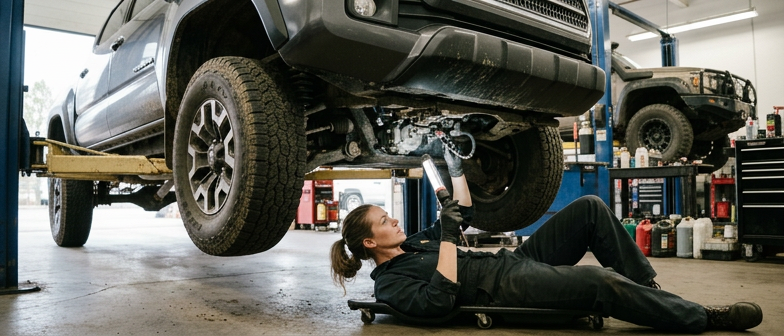
Modern four-wheel-drive systems blend mechanical components, electrical circuits, and software to send power to all four wheels. A transfer case behind the transmission divides torque to the front and rear driveshafts and provides high and low ranges. Many late-model trucks use electronic switches, control modules, encoder motors, and actuators instead of manual levers. The front axle may rely on a disconnect or hub system that must lock in for true four-wheel drive. A fault in the transfer case, front axle, wiring, or control module can all cause the same complaint that four-wheel drive will not engage, so technicians usually evaluate these parts together before deciding whether the issue is internal wear or something like a transfer case actuator that can be repaired separately.
When four-wheel drive or 4 Low does not engage, typical signs include flashing or inactive indicator lights, no change from two-wheel drive, or clicking from the transfer case without added traction, which can point toward front axle engagement problems. Drivers may also notice grinding, clunks, or binding if the system only partly engages. Before approving major work, shops often inspect the actuator and encoder motor, check fuses and wiring, and confirm how the front axle is operating. Explaining whether both 4 High and 4 Low fail, when the issue started, and whether it is intermittent helps a mechanic distinguish between electrical control or programming concerns and mechanical damage when estimating transfer case or front axle repair options.
A typical sign of 4WD not engaging is switching from two‑wheel drive and feeling no extra traction on gravel, snow, or mud. The dash light may keep flashing, stay off, or show a service 4WD warning, which often points to an electrical or control module issue rather than a purely mechanical failure.
When 4 Low fails to engage, the vehicle usually accelerates and shifts like 4 High or two‑wheel drive instead of showing slow, high‑torque behavior. Drivers may notice grinding, clunks, or a brief attempt to engage before it drops out, which can indicate internal transfer case wear or a problem with the actuator or encoder motor.
Front axle engagement problems appear when the front wheels do not help even though 4WD is selected. Clicking, humming, or buzzing from a vacuum or electric actuator without a firm pull at the front, or steering feel that changes as drive comes and goes, often leads technicians to inspect the front axle actuator, related lines or wiring, and transfer case output.
When a four wheel drive system will not engage, a structured diagnosis helps avoid unnecessary parts replacement and gives clearer information before approving repairs. Technicians first confirm the symptom, note whether the issue appears in high range, low range, or both, and check whether a service 4WD warning light is on. They consider when the concern started, whether it is intermittent, and if it followed heavy use or recent service. Visual checks focus on wiring to the transfer case actuator and front axle, looking for damage, corrosion, loose connectors, fluid leaks, or impact to the transfer case housing. Because many systems are electronically controlled, an initial scan for fault codes helps show whether the problem is mainly electrical, mechanical, or a mix of both.
After this first scan, diagnosis shifts to testing parts that determine whether the system can lock in properly. A technician may test the transfer case actuator by commanding engagement, listening for motor operation, and feeling for movement, then comparing those observations with data from the control module. If low range will not engage, they verify that operating conditions such as speed and transmission gear are correct and confirm that the transfer case range sensor reports position accurately. Where the front axle engages separately, the mechanic checks any disconnect or vacuum devices for proper response and may inspect linkages or manually move the encoder motor to separate control issues from internal mechanical faults. Throughout, they verify power and ground at key circuits so an electrical supply problem is not mistaken for a failed actuator.
Before recommending major work, such as transfer case replacement or control module programming, many shops follow an inspection checklist and explain how diagnostic fees relate to any repair that follows. A careful transfer case inspection includes checking fluid level and condition, looking for metal particles that suggest internal wear, and listening for abnormal noises during shifting attempts. When modules are suspected, staff may review software bulletins and outline a possible cost range for reprogramming, noting that actual pricing depends on labor time and vehicle configuration. Service advisors often clarify whether the initial diagnostic fee is credited toward the repair or billed separately, and under what conditions the fee still applies if further work is declined. Asking for a written summary of findings, test results, expected turnaround time, and recommended next steps helps the owner compare options and make a considered decision about 4WD repairs.
When a 4WD system will not shift into high or low range, technicians usually start by checking the transfer case actuator. With the vehicle safely supported, they look for damage or corrosion on wiring, connectors, and the actuator housing, then verify power and ground at the connector with a multimeter while the 4WD switch is operated. A scan tool can command different ranges and compare requested mode, position feedback, and stored trouble codes. Lack of movement, slow response, or mismatched data points toward electrical or mechanical faults in the actuator or its control module.
If the design uses an encoder motor, it can be removed and tested on the bench. The technician applies controlled voltage, watching current draw and rotation to confirm the motor reaches its stops smoothly without binding. For systems that send a digital position signal, the output is observed with a scan tool or oscilloscope while the motor is cycled to catch dropout or erratic readings. These tests separate a worn motor or gear set from issues elsewhere in the drivetrain and guide decisions about labor time, transfer case actuator repair cost, and whether to replace the whole unit or only the encoder motor.
Modern 4WD systems rely on wiring, sensors, switches, and control modules, so a 4WD that will not engage is often an electrical or electronic fault rather than a purely mechanical problem. Common clues include a 4WD or Service 4WD warning light that stays on, flashing mode indicators without the system actually engaging, or the vehicle dropping back into two‑wheel drive. In push‑button or dial setups, the dash switch sends a request to a module, which then operates the transfer case actuator, encoder motor, and front axle components. An electrical repair shop will typically confirm power and ground at key points, check fuses and relays, and compare switch signals and module outputs with what should occur in 4 High or 4 Low, using wiring diagrams and scan tool information.
During diagnosis of the 4WD control module and related parts, technicians usually scan for fault codes, monitor live data from sensors and switches, and test whether the transfer case actuator, encoder motor, and front axle engagement respond to commands. If the module appears suspect, they may look for water intrusion, internal shorts, or communication problems on the vehicle network before deciding whether software programming or full replacement is more appropriate. Programming and labor costs depend on the vehicle and equipment, and are often discussed together with any required wiring repairs. Some shops apply the initial diagnostic fee to the completed repair, while others keep it separate, so drivers are generally advised to ask how the fee is handled and what electrical tests are included.
Programming time and cost for a 4WD control module depend on vehicle design, the specific fault, and how the 4WD system is wired into other electronics. Newer trucks and SUVs may require extra diagnosis of wiring, sensors, or data networks before any reprogramming. Having accurate service information, suitable scan tools, and a stable power supply also influences labor time and the final bill.
Shop policies and workflow shape overall repair turnaround for issues like 4WD not engaging. Many facilities treat programming as one step in a process that verifies the complaint, checks for trouble codes or communication faults, and tests 4WD operation afterward. Labor for these checks, software licensing, road tests, and documenting results all contribute to the total programming cost.
What are common reasons a 4WD will not engage from the dash switch?
Frequent causes are a faulty transfer case actuator or encoder motor, worn transfer case parts, a front axle that does not lock, low or wrong fluid, or electrical problems such as bad connectors, fuses, or the control module.
How is a Service 4WD warning light usually checked?
Technicians confirm the symptom, scan for 4WD codes, inspect fuses, relays, and wiring, and review live data from switches, sensors, and the control module to see whether the system reacts to each selected mode.
What factors influence 4WD control module programming cost and time?
Cost and turnaround depend on labor rates, how difficult the module is to access, and whether extra diagnostics or network checks are needed. Parts availability and any added electrical testing also affect total time.
How is a transfer case actuator tested before major repair or replacement?
A mechanic verifies power and ground at the connector, commands 4 High and 4 Low with a scan tool, listens or feels for movement, and compares position feedback with expected values before considering transfer case work.
Does the diagnostic fee for a 4WD that will not engage usually go toward the repair?
Policies vary. Some shops apply part or all of the diagnostic charge if you proceed with repairs there, while others keep it separate. Ask in advance and request that test findings be documented.