
x
Manufacturers exploring extrusion machinery need to balance tight‑tolerance technical requirements with practical choices on custom equipment suppliers and financing. This overview helps you compare line configurations, downstream pipe and profile systems, and lending or leasing options, including key documents and eligibility checks.
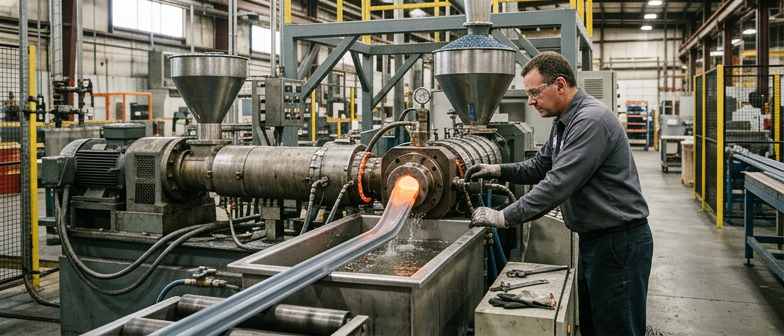
Extrusion machinery melts, mixes, and shapes thermoplastic or rubber materials into continuous products such as pipes, profiles, sheets, and films. A rotating screw inside a heated barrel conveys and compresses the material until it is uniformly melted and forced through a die that defines the cross section. Downstream cooling, sizing, and cutting equipment must operate in coordination to keep melt temperature, pressure, and line speed stable. For applications with tight dimensional tolerances, including precision profiles or small-diameter tubing, lines typically use closed-loop control of screw speed, melt pressure, and haul-off speed, combined with accurate temperature zoning and carefully engineered dies to reduce variation in wall thickness, weight per length, and surface quality.
The main extruder designs are single-screw and twin-screw, chosen according to material and process requirements. Single-screw machines are widely used for standard PVC pipe, straightforward profiles, and other applications where formulations are established and mixing demands are moderate. Twin-screw extruders, offered in co-rotating and counter-rotating versions, provide enhanced mixing, degassing, and feeding of powders or highly filled compounds, supporting complex formulations and consistent properties across the product. Within these machine types, specialized lines exist for profiles, pipe and conduit, wire coating, and sheet production. Many suppliers of profile extrusion equipment integrate the extruder with custom dies, calibration tables, and pullers so the line configuration matches the required geometry and precision level.
In extrusion lines, downstream equipment completes the transition from molten material to finished pipe and profiles with stable dimensions. After the extruder and die, sizing sleeves, vacuum tanks, and cooling baths control diameter, wall thickness, and straightness, which is essential when tight tolerances are required for pressure pipe or technical profiles. Haul-offs keep line speed consistent so the product remains in contact with sizing elements, while inline measurement systems track dimensions and surface quality and provide feedback to operators. For PVC and other thermoplastics, this coordinated cooling, calibrated sizing, and continuous measurement distinguishes general-purpose extrusion machinery from systems configured for demanding tolerance and repeatability needs.
Specialized pipe processing extends this controlled approach to end forming and finishing. Pipe belling machines heat and shape pipe ends to create sockets that must align reliably with compatible fittings, and are often combined with cutting, chamfering, and marking stations downstream. For complex window, door, or technical profiles, dedicated profile extrusion lines are paired with custom tables, saws, and handling systems supplied by companies that focus on profile tooling and layout. When organizations request detailed quotations for PVC pipe downstream systems or compare machines offered for sale, they typically review how well the equipment supports consistent quality, changeover flexibility, and alignment with planned extrusion throughput rather than considering nominal capacity alone.
| Selection Factor | Pipe Belling & End Forming | PVC Pipe Downstream & Profiles |
|---|---|---|
| Line compatibility | Matches pipe diameter and heating method | Sized for extruder output and cooling layout |
| Automation and control | Repeatable socket forming with basic controls | Coordinated haul-off and inline measurement |
| Tolerance and quality needs | Socket geometry suitable for tight fit-up | Stable diameter, wall thickness, straightness |
| Changeover flexibility | Adjustable tooling for different pipe sizes | Quick setup for varied PVC pipes and profiles |
| Maintenance and support | Accessible heaters and forming tooling | Serviceable tanks, sleeves, and handling units |
When assessing custom extrusion machinery and profile extrusion suppliers, buyers can focus on engineering support for material behavior, dimensional targets, and die and cooling design needed for tight tolerances. For PVC pipe lines, it is useful to confirm how the extruder will integrate with downstream equipment such as belling and cutting, and to request a quote that distinguishes core machinery from auxiliary systems. A shared information package with product drawings, throughput goals, layout and utility limits, control preferences, and documents needed for PVC pipe downstream pricing helps vendors submit technically comparable proposals and clarify responsibilities for installation, training, and performance checks.
Manufacturers investing in new or used extrusion lines often compare equipment loans with operating or capital leases. An equipment loan provides funds to purchase the line, with the machinery typically serving as collateral and ownership transferring after full repayment under lender conditions. A lease instead grants the right to use an extruder or downstream equipment for a set term, with options such as renewal, return, or purchase depending on the contract. The choice between leasing and borrowing generally depends on cash flow, expected service life of the line, accounting treatment, and the plant’s plans for future upgrades.
Financing used extrusion machinery can involve closer review of equipment age, condition, and resale value. Some financiers focus on preowned equipment and may request detailed specifications, maintenance records, and independent valuations before deciding. For startups, eligibility for extrusion-related financing often depends on the business plan, team experience, projected production volumes, and available collateral or guarantees. Early-stage firms may combine bank credit, specialist equipment lenders, and public support programs where available, each with its own approval criteria and documentation.
Across both new and used lines, common options include term loans, various lease structures, and sometimes dedicated machinery credit lines. Applications typically require recent financial statements, tax returns, equipment quotes or purchase agreements, and information about existing obligations, but exact documentation and credit thresholds are set by each provider. Comparing several offers helps manufacturers understand interest rates, fees, total cost over the contract term, and any conditions linked to equipment use, insurance, or resale. Because decisions and terms depend on individual financial profiles and lender policies, general descriptions should be treated as examples rather than fixed outcomes.
| Option | Ownership at End of Term | Cash Flow Predictability | Fit for New vs. Used Lines | Typical Use Case |
|---|---|---|---|---|
| Equipment loan | Ownership after full repayment | Medium predictability | Common for new lines | Long‑term core extrusion capacity |
| Operating lease | Usually no ownership | High predictability | Flexible for new or used | Access to updated extruders without commitment |
| Capital lease | Economic ownership expected | Medium to high predictability | Often used for new lines | Structured path to ownership with staged upgrades |
| Loan for used machinery | Ownership of preowned assets | Medium predictability | Focused on used lines | Cost‑conscious expansion of extrusion output |
New extrusion startups often face closer review when financing their first line. Lenders may focus on the founders’ experience, personal credit, collateral, and the business plan, and may suggest different forms of equipment or small‑business lending, each with its own eligibility criteria, documentation expectations, and timelines.
Financing used extrusion machinery can involve additional questions about condition, valuation, and remaining life. Lenders may request inspection reports or appraisals and adjust terms for age and specifications. Comparing leases, conventional loans, and vendor‑linked financing, including how they treat down payments, maintenance duties, and end‑of‑term options, helps align costs with long‑term capacity plans.
When a business pursues funding for extrusion machinery, lenders usually review overall eligibility before assessing the equipment. Typical factors include the legal form of the business, years in operation, revenue trends, and how the extruder and any downstream units will be integrated into production. Basic information about the extrusion line, such as capacity, materials processed, and whether the assets are new or used, helps institutions gauge collateral value and resale risk. Criteria differ among commercial banks, equipment finance providers, and public programs, so applicants need to verify requirements with each lender instead of assuming a single standard.
Credit analysis is central to most extrusion equipment financing decisions. Underwriters often consider owners’ personal credit profiles, the company’s credit history, and current debt obligations to assess repayment capacity. Beyond credit scores, they may review payment patterns, prior delinquencies, and experience with earlier equipment loans or leases. Cash flow from financial statements and bank activity is examined to see whether projected payments for the machinery fit within operating budgets. Some programs weigh collateral and guarantees more heavily, while others focus on cash flow and business plans, so it is important to ask how a specific lender balances these elements.
To support this review, lenders typically request defined machinery financing application documents. Common items include recent financial statements, tax returns, bank statements, proof of business registration, and a detailed equipment quote or purchase agreement identifying the extruder, related pipe or profile downstream equipment, and total acquisition cost. Younger companies may be asked for a business plan or production forecast describing how the new line will expand capacity or serve additional customers. For specialized or tight‑tolerance extrusion systems, technical specifications and supplier proposals can be required. Because document lists and thresholds are set by each institution or program, applicants should consult official guidance to confirm exactly what is needed before submitting a full application.
What core factors should I check when comparing custom extrusion machinery suppliers?
Review their experience with your materials, ability to meet your tolerances, die and cooling design support, integration with downstream equipment, and clarity of their installation and performance responsibilities.
How do equipment loans differ from leasing an extruder line?
With a loan, you buy the machinery and repay over time, using the equipment as collateral. A lease lets you use the line for a term, with options such as renewal, return, or purchase depending on the contract.
What documents are commonly requested for extrusion equipment financing?
Lenders often ask for financial statements, tax returns, business registration, details of the extrusion line, supplier quotes, and a business plan explaining how the machinery will generate revenue.
Are startups eligible for financing used extrusion machinery?
Some lenders consider startups, but they usually review founders’ experience, personal and business credit, available collateral, and the realism of the startup plan before deciding.
How can extrusion lines maintain tight dimensional tolerances?
They typically use precise temperature zoning, closed-loop control of screw and haul-off speeds, stable cooling and sizing, and well-designed dies to limit variation in dimensions and surface quality.