
x
As AI and GPU racks push beyond what legacy air systems can handle, operators need a clear path from rear-door heat exchangers to CDU-based liquid cooling. This guide compares options, costs, and retrofit requirements so you can plan reliable, scalable cooling capacity for high-density deployments.
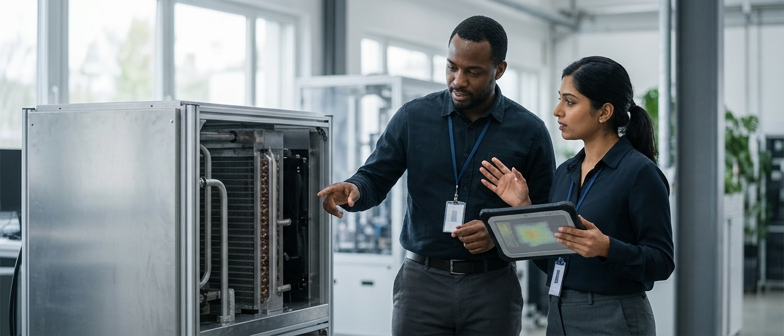
Advanced cooling solutions for data centers are now essential as operators push rack power densities beyond what traditional air systems can support. High-density AI racks and accelerated computing clusters concentrate tens of kilowatts per rack, overwhelming legacy hot aisle and raised floor designs. To keep environments reliable and energy efficient, cooling must be treated as a strategic resource. Modern approaches blend targeted airflow with liquid-assisted technologies and closer coordination between IT and facility teams, so thermal performance scales with compute demand instead of capping growth.
As leaders plan new AI deployments, they must evaluate practical cooling options for high-density AI racks and how each choice fits into a broader cooling capacity plan for AI growth. Decisions about rear-door heat exchangers, direct-to-chip liquid loops, or upgraded air systems influence energy use, usable white space, resilience, and retrofit flexibility. A clear capacity plan ties forecasted AI workloads and rack densities to available facility water and power, allowing cooling to be right-sized. Aligning technology roadmaps with scalable cooling architectures early reduces thermal risk, avoids emergency retrofits, and preserves budget and uptime.
As rack densities climb, advanced cooling solutions for data centers must be matched to clear power and thermal tiers. For moderate loads, improved air systems with containment and efficient CRAHs can still work, but sustained AI utilization quickly exceeds what air can remove. At that point, many operators adopt rear-door heat exchangers that pull most heat off at the rack and tie into existing facility water, avoiding major server redesign. These doors support a transition period with mixed conventional and AI hardware, but their effectiveness is limited by building water temperature and capacity and by how much airflow dense chassis can support.
For the highest-density AI racks, direct liquid cooling becomes the primary architecture, and teams compare rear-door heat exchangers versus coolant distribution units that feed cold plates or immersion tanks. CDUs decouple IT coolant from facility water, giving finer temperature control and more flexible deployment as AI clusters grow. When selecting cooling options for intensive AI racks, planners should consider integration complexity, liquid cooling maintenance requirements, access for service, and how each design fits into a broader cooling capacity plan. Many sites adopt a staged model in which rear-door solutions handle near-term density increases, while CDU-based direct liquid cooling is reserved for extreme AI environments.
| Cooling Architecture | Density Suitability | Integration Complexity | Risk & Operational Profile | Best-Use Scenario |
|---|---|---|---|---|
| Enhanced air with containment | Low to medium AI density | Low integration impact | Lower liquid risk, airflow dependence | Incremental upgrade in existing rooms |
| Rear-door heat exchangers | Medium to high density transition | Medium, uses facility water | Moderate liquid risk, water temperature sensitive | Bridge between conventional and AI racks |
| CDU-based direct liquid cooling | Highest-density AI racks | High, dedicated liquid loop | Higher liquid exposure, controlled by CDUs | Purpose-built AI clusters and growth phases |
Rear-door heat exchangers solve the thermal problem at the rack, capturing exhaust air and transferring heat to facility water while keeping most room airflow and cooling unchanged. Centralized cooling distribution units instead deliver liquid to cold plates or in-rack loops across multiple high-density enclosures, which makes them better suited for AI and GPU racks that exceed what air-assisted rear-door cooling can handle.
In retrofit projects, the rear-door versus CDU choice should be checked against a clear data center retrofit requirements checklist that includes floor loading, rack layout flexibility, return water temperatures, and available facility water capacity for liquid cooling. Rear-door units can limit changes to existing chilled-water piping but may complicate rear access and containment, while CDUs require more planning for headers and controls yet provide finer flow and temperature management and better scalability. Because this decision affects both rack-level and facility-level behavior, many operators turn to specialized data center cooling integrators near them to compare leak detection strategies, confirm redundancy needs, and translate these engineering findings into practical trade-offs on cost, risk, and ongoing serviceability.
Designing liquid cooling for high-density and AI-heavy racks starts with a clear rack-level power and heat budget. Maximum IT load in kilowatts, typical utilization, and allowable inlet temperatures determine coolant flow rates, supply and return temperatures, and acceptable approach temperature. CDU sizing for high-density racks must match the combined rack heat load, redundancy targets, and pump performance, with realistic safety margins. CDU capacity should align with current peak demand while leaving headroom for near-term AI growth so the liquid loop remains stable during training spikes and hardware refresh cycles.
With capacity defined, teams can estimate liquid cooling cost per rack and compare it with enhanced air-cooled configurations. A per-rack model usually includes each rack’s share of CDU cost, manifolds, hoses, heat exchangers, controls, installation labor, and commissioning. Energy use, water treatment, and ongoing service are included to reflect liquid cooling maintenance requirements. When capital expenses are combined with projected operating costs, the resulting cooling system total cost estimate shows whether liquid solutions support higher revenue per square foot through denser AI racks, or whether selective liquid deployment is more economical.
Final sizing must be checked against facility water capacity for liquid cooling and overall distribution limits. Engineers confirm that building chilled water, condenser water, or dedicated heat rejection systems can provide the required flow and temperature for all racks served by each CDU, accounting for diversity, seasonal variations, and redundancy so a single plant issue does not disrupt critical AI workloads. Where plant capacity is constrained, designers may prioritize the highest-density racks or phase upgrades, integrating these limits into the long-term cooling capacity plan for AI growth.
A practical cooling capacity plan for future AI growth starts with projected rack power density and per-rack heat load over three to five years. Teams map these loads to liquid cooling requirements such as coolant flow, approach temperature, and redundancy, then check that facility water capacity for liquid cooling—chillers, pumps, and distribution loops—can support peak AI workloads with a safety margin and room for high-density expansion. For budgeting, teams build a cooling system total cost estimate that separates capital spending from operating costs. At the rack level they calculate liquid cooling cost per rack, including manifolds, cold plates or rear-door units, controls, and integration labor, and convert this to an annual cost per kilowatt of IT load. At the facility level they add central plant upgrades, water treatment, monitoring, and maintenance to align long-term ownership cost with planned AI capacity.
When existing facilities retrofit for advanced cooling solutions for data centers, the work starts with a structured requirements checklist covering building, water, and control changes. Operators confirm floor loading, rack layouts, and containment for cold plates, rear-door heat exchangers, or coolant distribution units, and adjust cable routing to preserve airflow. The checklist also verifies facility water capacity for liquid cooling, checking loop temperatures, redundancy, water treatment, and isolation valves at the IT interface. Control upgrades link the building management system with new liquid and air cooling controls so valve positions, pump speeds, and water supply temperatures track changing IT loads and growing AI density. Early engagement with local data center cooling integrators helps turn design intent into buildable solutions and reduces integration risk between mechanical systems, power, and deployment plans.
After physical and control changes are defined, formal data center cooling commissioning services confirm that the retrofitted system meets design across normal and failure scenarios. Commissioning teams test startup, failover, and emergency procedures, validate sensor placement and calibration, and confirm that setpoints maintain server inlet conditions under realistic workloads. As liquid systems are added, operators should compare liquid cooling leak detection approaches, such as flow and pressure monitoring, point sensors in trays, and fiber-based detection cables, and select coverage that fits their risk tolerance and maintenance practices. The resulting commissioning documentation becomes the baseline for operations and future expansions, giving facility teams confidence that the upgraded cooling infrastructure is ready to support higher-density racks while protecting uptime.
Why do high-density AI racks need advanced cooling?
AI racks often run above 30–60 kW, beyond typical raised-floor air systems. Advanced cooling keeps chips within spec, protects uptime, and improves efficiency so power density can increase without thermal limits.
How do you size a CDU for liquid-cooled high-density racks?
Sum the rack IT load in kW, add N+1 or N+N redundancy, then convert to required flow and temperature rise. Size the CDU for peak load plus margin, including pump head for manifolds and cold plates.
When is a rear-door heat exchanger better than a central CDU?
Rear-door units suit retrofits using existing facility water and mostly unchanged servers, removing most rack heat at the door. A central CDU is better when rack power is high enough to require direct-to-chip or in-rack loops.
What should be on a data center retrofit checklist for liquid cooling?
Check floor loading, rack layout, containment changes, liquid line routing, isolation valves at IT, water chemistry and filtration, BMS integration, and that facility water capacity and redundancy support future AI loads.
What maintenance and leak detection are needed for liquid-cooled racks?
Schedule filter replacement, flow and valve checks, glycol or inhibitor tests, and sensor calibration. Use drip trays, cable-type leak sensors, or pressure monitoring, and define procedures to isolate and dry affected racks quickly.