
x
Facing a knocked-out or badly damaged tooth, you may be unsure whether it can be replanted, how urgent care works, and what it might cost. This guide explains when tooth replantation is possible, what happens during splinting and healing, and how dentists assess future treatment or replacement options.
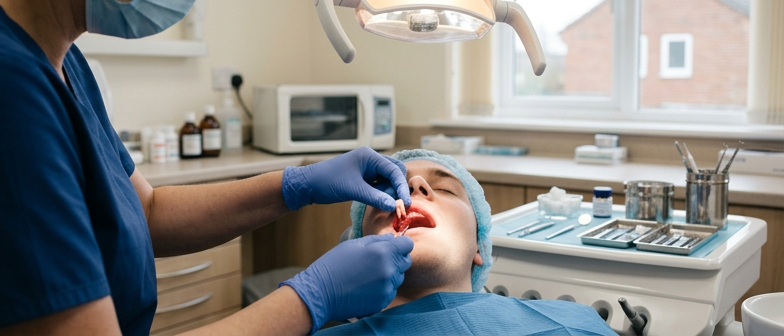
Tooth replantation is an emergency procedure in which a tooth that has been completely knocked out is gently placed back into its original socket. It is usually considered for permanent adult teeth that have been avulsed by a sudden injury, such as a fall, sports impact or accident, when the tooth and surrounding tissues are in a suitable condition. Unlike dentures, bridges or implants, this approach aims to preserve your own tooth and its natural bite. Before deciding if a tooth can be put back, a dentist assesses the root, the health of the gum and bone, and how long the tooth has been out of the mouth, as these factors strongly influence the chances of success.
Replantation is not appropriate in every situation, so urgent professional assessment is important when someone arrives with a knocked-out tooth. Adult teeth may be candidates if they have been handled carefully, kept moist and the socket is not badly damaged, whereas baby teeth are generally not replanted because of the risk to the developing permanent tooth underneath. During emergency care, the dentist will check for other injuries to the face and jaws, examine the empty socket, nearby teeth and soft tissues, and decide whether repositioning the tooth is safe and worthwhile. If the socket is fractured, heavily contaminated or there are relevant medical concerns, an alternative treatment plan is usually recommended.
When a permanent adult tooth is completely knocked out, a dentist may try to replant it if you reach urgent care quickly and the tooth is kept clean and moist, for example in milk or saliva. Hold it by the crown, avoid touching or cleaning the root, and seek an emergency dentist promptly, as the ligament cells on the root surface can be damaged within a short time. In contrast, an avulsed baby tooth is usually not replanted, because putting it back can interfere with the developing adult tooth underneath and offers limited long‑term benefit for the child.
When a tooth is knocked out and replantation is considered suitable, the dentist first focuses on gentle cleaning and assessment. Visible dirt may be rinsed away while trying not to damage any remaining ligament fibres on the root surface. The socket is examined for fractures, injury to nearby teeth, and debris that must be removed. If the tooth has been stored appropriately, such as in milk or a suitable solution, it is repositioned into the socket with firm but controlled pressure so it sits in its original alignment with neighbouring teeth. Local anaesthetic is usually given to keep the procedure comfortable and to allow a careful check of the area.
Once the tooth is back in place, it is typically stabilised with a splint. This is often a fine wire or fibre material bonded to the replanted tooth and adjacent teeth to limit movement while the supporting tissues start to heal. In many cases the splint stays on for about two weeks, though the exact timing depends on the type of injury and the clinician’s judgement. During this phase, patients are advised to eat a soft diet, avoid biting directly on the treated tooth, and keep the mouth clean with gentle brushing and, where recommended, an antibacterial mouthwash. Early review appointments allow the dentist to confirm that the tooth position is stable, the splint is intact, and there are no clear signs of infection or marked pain.
In the following weeks and months, healing is monitored so that problems such as root resorption or infection can be identified promptly. Some sensitivity or dull aching can occur as tissues recover, but worsening pain, swelling, or an unpleasant taste may indicate infection and should lead to urgent reassessment. Clinical examination and radiographs help the dentist decide whether additional care, such as root canal treatment or specific management of root resorption, is appropriate to support the tooth. The longer term outlook depends on how quickly the tooth was replaced, how it was stored beforehand, the condition of the socket, and how closely the person follows aftercare advice and attends scheduled follow-up visits.
| Stage | Main Focus | Typical Patient Experience | Monitoring Priority |
|---|---|---|---|
| Immediate cleaning and repositioning | Protect root surface and socket | Local anaesthetic, controlled pressure | Check alignment and socket condition |
| Splinting and early stabilisation | Limit movement, support healing tissues | Soft diet, avoid biting on replanted tooth | Review splint integrity and comfort |
| First follow‑up visits | Confirm stable position and early healing | Brief checks, possible sensitivity | Watch for pain, mobility, early infection signs |
| Ongoing healing and root resorption risk | Assess root and bone response | Intermittent dull ache or sensitivity | Radiographs to detect resorption or changes |
| Management of complications | Treat infection or damaged root | Possible root canal or further procedures | Decide on supportive care or replacement options |
After a tooth has been replanted, it is usually supported with a small splint attached to the neighbouring teeth, using a thin wire or composite material. This flexible support keeps the tooth stable while the ligament and bone heal, yet allows limited natural movement, which is generally considered better for recovery than very rigid fixation. For many uncomplicated injuries the splint is kept in place for about two weeks, but more severe damage to the tooth or its socket may require a longer period, decided on after clinical assessment.
When the splint is removed, follow‑up visits are used to check healing and to look for problems such as infection or root resorption, where the root structure gradually breaks down. Dentists usually rely on clinical examination, tests of biting comfort and periodic X‑rays to compare changes over time. If infection or resorption is suspected, options can include root canal treatment, medicated dressings or referral for specialist care. New or worsening pain, swelling, bad taste or increasing looseness should prompt an urgent appointment so potential complications are assessed as early as possible.
Tooth autotransplantation means moving one of your own teeth, often a wisdom tooth or premolar, into a space where a tooth is missing or cannot be saved. You may be suitable if you have a donor tooth with a compatible root shape and size, enough bone in the area receiving the tooth, and generally healthy gums and teeth. This planned procedure differs from emergency replantation of a knocked-out tooth, which aims to place the same tooth back into its original socket as soon as possible. Assessment usually involves X‑rays, checking your bite and cleaning habits, and comparing autotransplantation with alternatives such as implants or bridges, including the possibility that further treatment may be needed if the transplanted tooth does not settle.
The long-term outlook after replantation or autotransplantation depends on how the tooth was handled, how quickly it was placed back and individual healing. A key risk is root resorption, where the root gradually breaks down; it may sometimes be managed with monitoring, root canal treatment and bite adjustments, but in some cases the tooth is eventually lost. A tooth that has dried out for a long period before replanting is less likely to survive, so a dentist may advise another way to restore the gap. If a replanted tooth fails, replacement with an implant, bridge or removable denture involves extra cost, which varies with the type of restoration, any preparatory work and local fees, and is usually discussed in advance during planning and consent.
Dentists usually consider tooth autotransplantation or other replacement options when a damaged or replanted tooth cannot be predictably maintained, for example after major trauma, extensive decay or complex root resorption. Suitability for moving another tooth into the space depends on age, jaw growth, general health, the condition of possible donor teeth and the bone and gum around the site. If the long‑term outlook for a replanted tooth is poor, alternatives such as a bridge, denture or implant may be discussed, along with likely procedures, risks and costs. In some emergencies a tooth that has dried out or become contaminated may still be repositioned, but the prognosis is less certain, with a higher risk of complications and a greater chance that future replacement will be needed.
Can an adult tooth be replanted if it is completely knocked out?
Yes, a permanent tooth can sometimes be replanted if you reach an emergency dentist quickly and the tooth is kept moist, ideally in milk or saliva, and the root is not scrubbed.
What happens during tooth replantation at the dentist?
The dentist gently rinses debris, checks the socket and nearby teeth, then repositions the tooth into its original place under local anaesthetic and usually stabilises it with a small splint.
How long does tooth splinting usually stay in place after replantation?
For a straightforward injury, a flexible splint typically remains for about two weeks, but more complex trauma may need a longer period based on follow‑up assessments.
Am I suitable for tooth autotransplantation instead of an implant?
You may be suitable if you have a healthy donor tooth of the right size, enough bone at the recipient site, and good gum health. Dentists confirm this with clinical examination and imaging.
What if I cannot afford urgent care for a replanted tooth infection?
In an infection you still need prompt assessment. You can ask local practices about emergency slots, reduced‑fee schemes, or community services that help with urgent dental costs.