
x
Whether you’re starting forklift training with no experience or booking a refresher, this guide explains course content, age rules, assessments and conversion options, plus how extras like telehandler qualifications and experienced‑driver checks affect the total cost and schedule of your chosen training path.
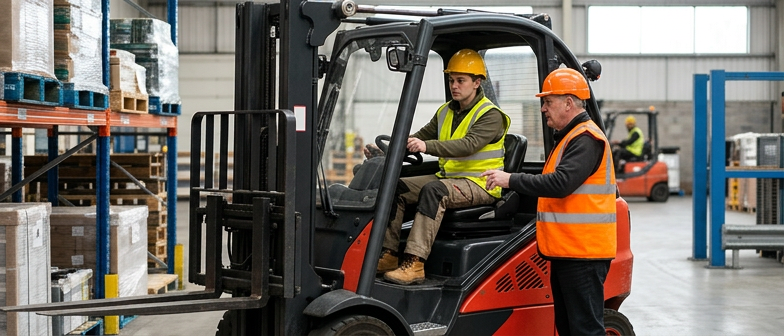
A formal forklift training course is designed to make operators safe and competent before they are allowed to use a truck in the workplace. Whether you are looking for forklift training without experience or returning to refresh your skills, the structure is similar. Training usually starts with an introduction to legal duties for employers and operators, the main types of lift truck, and the hazards in warehouses, yards and loading areas. You are shown how stability works, why loads can tip a truck, how to read capacity plates, and how to carry out a pre‑use inspection so that defects are spotted before the truck goes into service.
The course then moves into a mix of classroom learning and hands‑on driving practice, building up to a combined forklift theory and practical test. In the theory section you answer questions to show you understand safe systems of work, signalling, stacking and de‑stacking rules, pedestrian safety and site‑specific risks. During the practical assessment you must demonstrate precise control of the truck, correct use of the hydraulics, accurate handling of pallets at different heights and safe parking. Beginners are given a step‑by‑step approach with plenty of supervised practice before being tested, while experienced operators on shorter courses may move more quickly to formal assessment, but everyone must meet the same recognised standard to be signed off as competent.
When you search for a beginner forklift course near you, the first step is deciding whether you need full forklift training without experience or a more advanced option. New operators usually require a longer novice programme covering basic controls, safe manoeuvring, load handling and the forklift theory and practical test, with plenty of supervised practice. If you have never worked with lift trucks, choose a course that clearly states it is suitable for complete beginners and follows recognised standards, rather than a shortened or intensive programme aimed at people who already drive for work. Checking local training centres, online reviews and employer recommendations can help you find a nearby course with dates that fit around your job or job search.
If you already operate lift trucks, the better option is usually a focused forklift assessment for experienced drivers, or a short refresher if your skills are current but your certificate is close to expiring. An experienced operator route often starts with a skills check followed by targeted training to correct unsafe habits before you take the tests again. If your main aim is to renew your qualification, look for a forklift refresher course in your area and ask how to book a forklift refresher assessment, including what proof of previous training you need. Consider how often you use a truck, when you last trained and whether you are changing employer or truck type, and be honest about your experience so the provider can match you to the right option.
| Course type | Typical candidate | Main focus | Time and intensity | Best when |
|---|---|---|---|---|
| Beginner forklift course | No prior truck experience | Core skills and safety basics | Longer, steady pace | You are starting a new role |
| Experienced operator assessment | Regular current operator | Confirm existing competence | Short, focused session | You need proof for a new employer |
| Refresher course and assessment | Qualified but lapsed operator | Update knowledge and correct habits | Brief, targeted update | Your certificate is due for renewal |
A beginner or novice Forklift Training Course is aimed at people with no previous truck experience and is often advertised as an introductory course in your area. Training usually runs over several days and combines classroom sessions with practical driving. You start with how the truck works, site safety rules, pre‑use checks and basic load handling, then move on to supervised driving in a controlled area so you can build confidence at a sensible pace.
If you are starting forklift training without experience, providers normally expect reasonable spoken and written English so you can follow instructions and complete the forklift theory and practical test at the end. The theory checks your understanding of safety and regulations, while the practical assessment looks at steering, manoeuvring, stacking and de‑stacking. Before attending, read the joining instructions, revise common workplace traffic signs, and make sure you are well rested so you can concentrate.
For experienced operators, a focused forklift assessment is an efficient way to confirm ongoing competence without repeating a full Forklift Training Course. It is suitable when a driver already holds a certificate, is returning after a break, or an employer needs proof that standards are maintained. During a typical forklift assessment for experienced drivers, an accredited instructor reviews previous training records, asks key theory questions and observes practical driving, including safe manoeuvring, stacking, pre‑use checks and site rules.
If only minor gaps are found, you can book a forklift refresher assessment or a short refresher course with a local provider instead of starting again. A nearby forklift refresher course normally combines a brief theory update, targeted practical coaching and a short test on the trucks and tasks used at work. Forklift refresher training cost varies with course length, group size and location, so employers should request itemised prices showing what is included, such as registration, certification and any on‑site use of company vehicles or facilities.
On a formal Forklift Training Course in Great Britain, age rules and legal duties come from general health and safety law rather than a separate licence. There is no fixed legal age to operate a truck, but anyone driving on a public road must be old enough for the relevant road licence. Employers must be sure that younger workers are physically and mentally mature, and many set clear forklift course age requirements in company policy, check medical fitness where needed, and carry out a site-specific risk assessment before any new or younger operator uses equipment, even with supervision.
Employers must provide suitable and sufficient training, instruction and supervision, including refresher or corrective training when standards drop or work changes. Any compliant forklift training course therefore includes both theory and practical driving, with continued monitoring by competent supervisors to confirm safe systems of work are followed. Safety standards are supported by using properly trained instructors, well-maintained equipment, and accurate records of initial and refresher training, and by refusing unsupervised use of a truck until an operator has shown full competence in both classroom and practical elements.
A structured Forklift Training Course will explain the differences between common truck types before you operate any equipment. Counterbalance forklifts use weight at the rear to balance the load at the front, making them suitable for yards, loading bays and straightforward racking. Reach trucks are designed for narrow aisles and high lifts, with stabilising legs and a reaching mast so pallets can be placed deep into racking. Telehandlers, or telescopic handlers, are closer to plant machinery, using a boom that extends forwards and upwards for work on construction or agricultural sites. Because controls, visibility and stability vary between these machines, safe operation depends on understanding how each one steers, brakes, lifts and handles uneven ground or tight spaces.
If you already hold a certificate on one truck type, forklift conversion training near you lets you build on that experience rather than start again. A typical counterbalance to reach conversion course adapts your existing skills to the different mast, stability and operating techniques used in high-bay warehouses, combining focused theory, practical exercises and an assessment. Telehandler training is usually offered as a separate course, with the price and duration depending on whether you are new to forklifts, already experienced or only need short upskilling. When comparing telehandler course price and duration information, check what the fee includes, how much time is spent on practical driving and whether the course aligns with recognised workplace transport safety standards.
What does a typical forklift training course include?
It covers legal duties, truck types, site hazards, stability and load limits, pre‑use checks, safe manoeuvring, load handling and both the forklift theory and practical test.
How do I choose a beginner forklift course near me if I have no experience?
Look for a novice Forklift Training Course that clearly states it is suitable for complete beginners, follows recognised standards and offers several days of supervised practical training.
What are the usual forklift course age requirements in the UK?
There is no fixed legal minimum age for operating on private sites, but you must be old enough for a road licence on public roads and employers must be satisfied you are mature and medically fit.
What is a forklift refresher assessment and when should I book one?
A refresher assessment checks an experienced driver’s current skills through brief theory questions and observed driving; you should book a forklift refresher assessment every few years or after a long break.
How do conversion and telehandler courses affect total forklift training cost?
The forklift training total cost increases if you add conversion training, such as a counterbalance to reach course, or a telehandler course, with price and duration depending on your prior experience.