
x
If you want to practise trading without risking money, demo trading lets you test platforms, strategies and costs using virtual funds. The guide compares demo versus live trading, shows how to open and manage a free practice account, and explains where its limits and realistic benefits are.
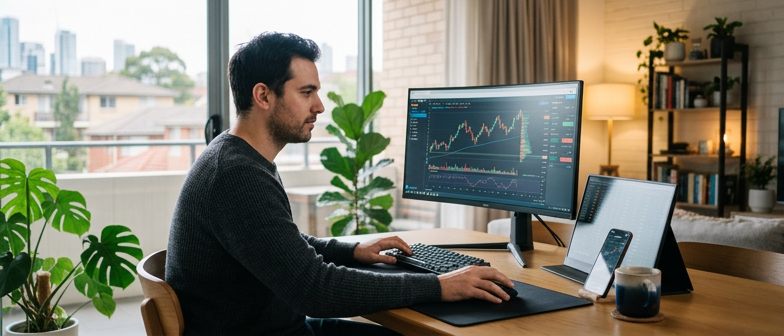
Demo trading uses a simulated version of a trading platform where prices follow real or near‑real market data, but the balance is virtual. You can place orders, test strategies and explore tools as if you were trading live, yet gains and losses do not affect your actual money. Many online brokers design demo accounts to resemble live accounts in layout, products and basic functions, so they offer a practical way to learn how markets, order types and margin work before committing funds. The experience still has limits, as it cannot fully reproduce slippage, execution variations or the emotional impact of seeing real profits and losses.
Risk‑free practice is useful for people exploring leveraged products or new asset classes, because it lets them build familiarity and test ideas while deciding whether trading aligns with their goals and tolerance for risk. A demo account can show how quickly prices move and how decisions would have played out, supporting new traders who are learning and more experienced traders who want to trial a different strategy or platform. Some find that simulated trading improves confidence and discipline, while others only recognise its limits when they switch to live trading and face greater emotional stress. Used with these caveats and combined with ongoing learning, a demo environment can help assess whether trading suits an individual’s experience, financial situation and appetite for risk.
To open a demo trading account, brokers typically ask for basic details such as your name, email address and sometimes a phone number, then invite you to choose a trading platform and starting balance. The process is usually handled through an online form and does not always require identification, because you are not depositing or withdrawing real money. Many mainstream platforms, including those used by brokers supervised by the Australian Securities and Investments Commission, offer practice accounts that closely resemble their live interface so you can learn how orders, charts and risk settings work before you trade with actual funds.
When assessing different providers, it is helpful to consider how closely the practice environment matches live conditions. Some firms stream demo prices from real market data, while others use indicative or delayed quotes, which can change how strategies behave. A demo from a locally regulated broker may indicate that the underlying live service is subject to conduct and disclosure requirements, but the practice account itself is not a guarantee of performance or a form of personal advice. Checking whether the virtual account offers the same product list as the live service, such as forex, indices or share CFDs, helps you judge how well your training will carry over to real trading.
Day‑to‑day management of a demo account involves watching your virtual balance, reviewing past trades and adjusting funds when the numbers no longer match your intended risk profile. Many platforms let you reset or top up the demo balance in the settings, and some allow several practice accounts so you can test different methods side by side. Providers may limit the number of active logins, the duration of access or the maximum simulated funds, so it is useful to read the terms for each platform. Treating these accounts as structured tools and closing or refreshing them when needed can support a more disciplined routine before you consider opening a live account.
| Process stage | Key choices | Considerations for AU traders | Typical broker limits |
|---|---|---|---|
| Initial sign‑up | Platform and account type | Prefer ASIC‑regulated platforms | Access duration may be capped |
| Account configuration | Starting demo balance | Align balance with realistic capital | Maximum virtual funds restricted |
| Product selection | Markets and instruments | Check forex, indices, share CFDs availability | Some products excluded from demo |
| Daily management | Monitoring and reviewing trades | Focus on risk and drawdown patterns | Inactivity can lead to closure |
| Balance adjustments | Reset or top‑up options | Use resets to test new strategies | Reset frequency sometimes limited |
| Multiple demos | Number of demo accounts | Separate accounts for different methods | Concurrent logins often controlled |
Most demo trading accounts are called free because you do not pay trading commissions or platform fees and you are not risking real money. However, the provider’s terms usually add conditions, such as expiry after a period of inactivity, limits on how often you can reset the virtual balance, or reduced access to some products and tools compared with a live account. Ongoing use may also require basic contact details or agreement to receive marketing, so the absence of direct payment does not mean the account is completely without constraints.
The number of demo accounts you can open is set by each broker. Some platforms allow several profiles so you can test different strategies or markets, while others link you to a single login and control how often you can refresh or reopen practice balances. If you want multiple demo environments, check the rules on account numbers, resets and inactivity closures instead of assuming unlimited access.
Demo trading platforms are built to imitate live market conditions so you can practise trading without risking money. Price feeds are usually live or close to real time, order types match those on a standard account, and you can test strategies in markets such as forex, indices, shares and commodities. This makes a demo account useful for learning how to place and manage trades and for gaining a basic feel for how prices move before using your own capital.
However, demo trading does not replicate every aspect of live trading. Spreads, margins and execution quality are often indicative rather than identical, particularly during volatile periods or major news events, and simulated environments rarely show slippage, requotes or partial fills in the same way as a real account. Because profits and losses are virtual, emotions are usually less intense, which can encourage risk taking or trade sizes that a person might avoid when real money is involved.
Demo trading can still be helpful when expectations are realistic. It is well suited to testing strategies, learning platform functions and developing routine and discipline, but it cannot fully prepare you for psychological pressure or all execution details. Many traders use demo results as a rough guide, then move gradually to a small live account to experience genuine pricing, real emotional responses and financial consequences while keeping overall risk limited as they continue to learn.
Demo platforms often show spreads and order execution that look smoother than live trading because prices are simulated, orders are not competing in a real market, and slippage or requotes can be limited. In a live environment, spreads vary with liquidity, news and volatility, and orders may be partially filled, delayed or rejected, so actual entry and exit prices for the same strategy can differ from what appears on a demo account.
Choosing between a demo account and live trading depends on your experience, objectives and ability to handle risk. A demo environment allows you to practise strategies, understand order types, margins and charting, and explore new platforms without putting real money at stake. At the same time, prices, execution and costs can differ from a live account, and the lack of financial pressure may lead you to take trades or risks you would avoid with actual funds.
Demo trading is most useful when you treat it as structured practice. Many traders use it to test a written plan, see how their approach behaves in different market conditions and learn to apply risk controls such as stop losses and position sizing. This can reduce technical errors once you trade live, but it does not remove market risk and cannot fully replicate the emotions that come with real gains and losses.
A practical path is to begin in demo mode, define clear conditions for switching and then move to a small live account once you can follow your plan consistently. Some people continue to run a demo account alongside live trading to trial new ideas or refine tactics while keeping real positions limited to amounts they can afford to lose. In this way, a practice account becomes an ongoing tool for testing and learning, rather than a permanent replacement for trading with real capital.
What is demo trading?
Demo trading uses virtual funds on a simulated platform with market‑linked prices. It lets you learn the interface, practise orders and basic risk management before using real money.
How can I open a demo trading account?
You usually fill in a short online form with contact details, choose a platform and a virtual balance. Formal identification is limited because no real deposits or withdrawals are made.
Does a demo account cost anything?
Providers generally do not charge trading or platform fees and you do not risk real capital. Some accounts have time limits, fewer features or marketing emails, so checking the terms is useful.
Are demo spreads and execution the same as live?
Not exactly. Because orders are simulated, spreads and fills may appear smoother and slippage lower. Live trading depends on real liquidity and volatility, so actual prices can differ from demo results.
Can demo trading help before going live?
It helps you practise placing orders and applying risk controls without financial loss. It cannot fully reproduce emotional pressure or all market conditions, so it is a training tool rather than a performance guarantee.